With the various high profile wars going on at the moment (and many more low-level ones the people don’t care about), I thought it was high time to post about something which is kind of the opposite of a war. The worlds oldest Alliance, some might say peace treaty though it didn’t involve two warring states.
It was all the way back in 1373 when the oldest and still very much surviving alliance was signed off and like many alliances today and back then (even if not formalised), the Anglo-Portuguese alliance was born primarily out of converging strategic interests.
An alliance between France and Castile (precursor to the kingdom of Spain) in 1369 had caused consternation at the English court. Fourteenth century Anglo-French relations mostly alternated between hostile rivalry at best to periods of open conflict and war at worst. Through the alliance with Castile, which had one of the largest fleets in Western Europe, France could utilise Castilian sea power, in its struggle against England. Therefore closer union with Castile’s western neighbour Portugal was a logical step to counter this threat. Added to this was a dynastic interest as the Duke of Lancaster, John of Gaunt, had a legitimate claim to the throne of Castile through his wife, Constance, daughter of the rather memorably named, Peter the Cruel (1334-1369).
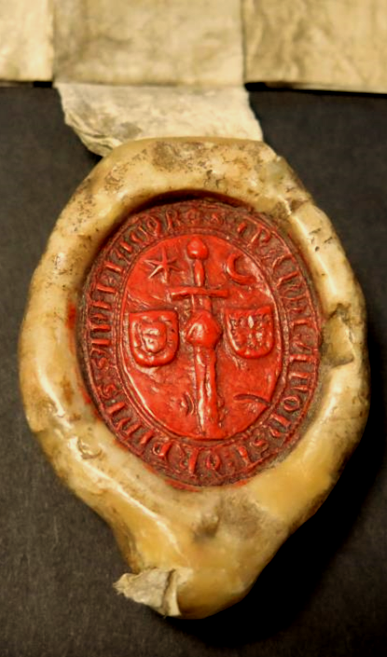
Below is the treaty of alliance sealed in 1373 between King Edward III and King Ferdinand I of Portugal

It was believed the answer to the strategic stalemate lay in the “Chemyn de Portugal” and the “Chemyn d’Esapigne” the “way of Portugal” and the “way of Spain” a reference to the policy of military intervention in Iberia. With military victory in the Iberian Peninsula and a Plantagenet on the Castilian throne, it would only be a matter of time before France would be forced to the negotiating table.
However the alliance and Portuguese independence itself was soon under threat of becoming extinct in the early 1380s.
England had already sent a failed expedition to Portugal in 1381-2 under the duke’s brother Edmund of Langley in an attempt to push Castile out of the war. It was even detrimental to the hitherto close Anglo-Portuguese ties. Undisciplined English troops had caused outrage by raiding Portuguese towns and killing inhabitants whilst exclusion from Portuguese-Castilian peace negotiations in 1382 drew English resentment.
This was shortly followed by a political crisis caused by the death of King Ferdinand of Portugal on 23rd October 1383. Ferdinand’s son in law was the Castilian King John I who began stripping away Portuguese independence in favour of political and dynastic union with Castile. Portuguese nationalist opposition rallied around King Ferdinand’s half-brother John of Aviz and resistance quickly escalated into civil war.
John of Aviz was desperate for outside military help and sent ambassadors to England to request permission to recruit soldiers there. The Portuguese ambassador Ferdinand Afonso de Albuquerque, Master of the Portuguese military order of St James succeeded initially in raising only a modest force of approximately 800 Anglo-Gascon troops. Nevertheless these soldiers would play a laudable role in the eventual defeat and withdrawal Castilian forces from Portugal particularly in their contribution to the victory over Castilian troops at the battle of Aljubarrota (14th August 1385).
Ten days after his coronation on 15th April 1385, King John of Portugal had instructed his ambassadors to negotiate an alliance with King Richard II of England and to raise much needed loans to pay his troops.
A breakthrough regarding these negotiations was slow in coming but a shift in policy towards Iberia, and the growing threat of a Franco-Castilian invasion in early 1386, created an English appetite for reaffirming its alliance with Portugal.
The Duke of Lancaster was also planning an expedition to Castile for the summer of 1386 and Portuguese military assistance would be almost essential. To sweeten the deal and demonstrate he was a serious ally, John agreed to dispatch a squadron of ten Portuguese galleys to be stationed in English waters to bolster protection of English shipping and England’s south coast.
On 9th May 1386 the original draft (protocol) of the treaty was produced and ratification of the treaty was enrolled in the ‘Treaty Rolls’ records in the office of Chancery finally on 1st December 1386.

The treaty didn’t achieve its immediate military/political objectives but it endured.
Perhaps the biggest legacy was the successful adherence to terms in the Treaty of Windsor that supported mutual military assistance and security. Although not invoked until several centuries later, the terms of the alliance were to be called upon during the eighteenth and nineteenth centuries when Portuguese independence was again threatened.
In 1762 Anglo-Portuguese forces successfully defeated a Spanish invasion force and again during the Peninsula war of 1808-1814, Anglo-Portuguese troops under the Duke of Wellington thwarted Napoleon’s attempts to conquer Portugal, most notably at the battle of Bussaco on the 27th September 1810.
Winston Churchill in a speech in the House of Commons in October 1943 famously described the unique and ancient friendship between England and Portugal as an alliance “without parallel in world history”
During WWII, Portugal proved that it was still strongly committed to the alliance. In spite of Portuguese neutrality in the war British Royal Navy ships were allowed to refuel in Portuguese ports and Portuguese planes participated in reconnaissance missions for the Atlantic convoys. Moreover in 1943 Portugal agreed to British and American air force squadrons being stationed in the Azores.
In a telegram to the Foreign Office dated 23rd June 1943, the British ambassador to Portugal Sir Ronald Hugh Campbell confirmed that the British government had invoked the 600 year old alliance between the two countries as a basis for requesting the use of military facilities on the Azores.
Even more recently in 1982, these bases on the Azores were again requested in 1982 during the Falklands conflict.
650 years on and the Anglo-Portuguese alliance is still a valid international agreement with no war having been fought between the two nations.

 Stephen Liddell