One of my favourite treasures of the British Museum always catches me by surprise at just how splendid it is. Take a look at this wonderful cape below.
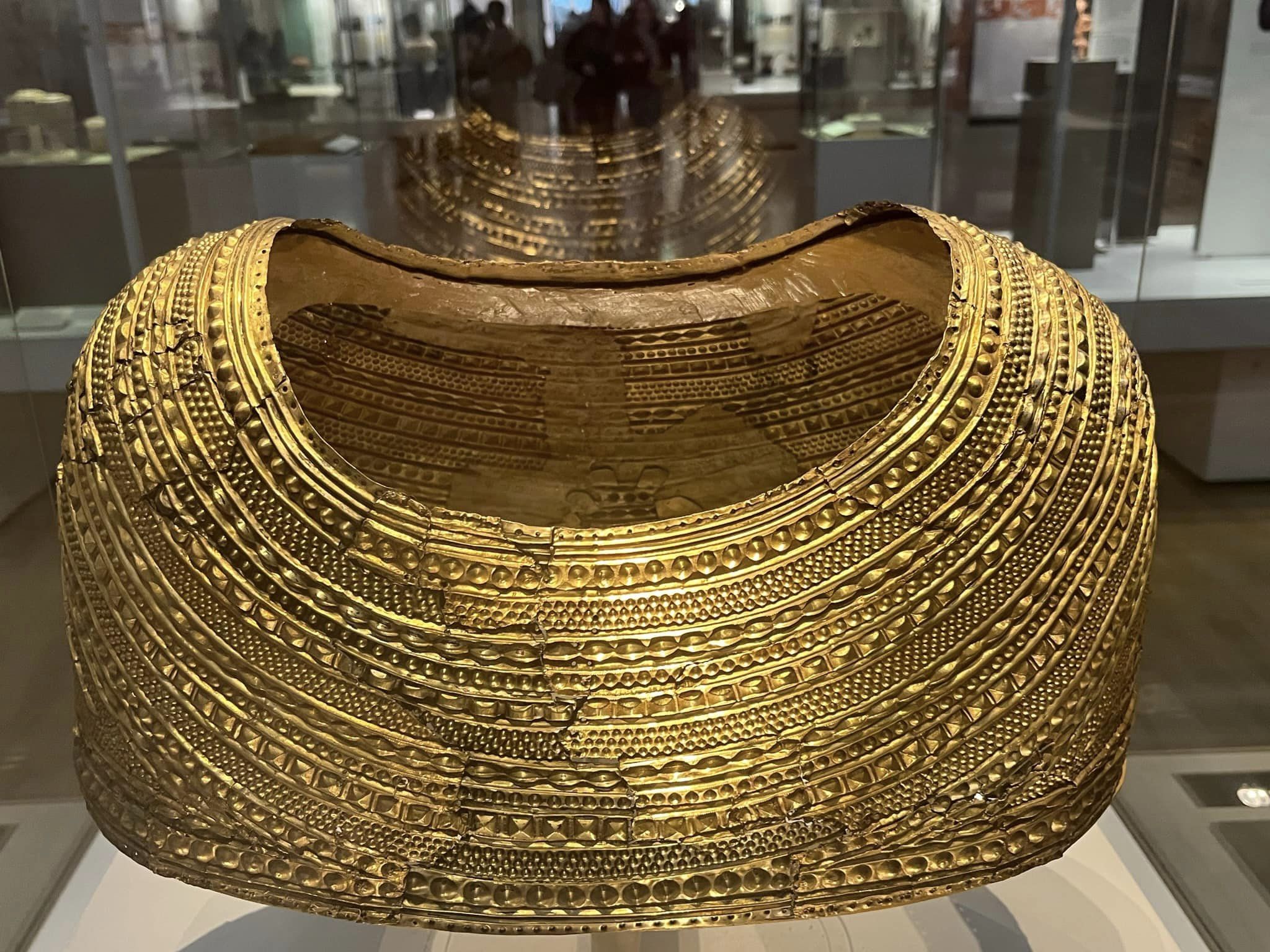
This is one of if not the finest prehistoric gold sheet workings in the entire world. It’s not from some fancy and famous ancient civilisation. Having been created around 1900BC it is almost 4,000 years old and it is not a treasure of a Pharaoh and found deep beneath the Pyramids. It’s actually British and was discovered by quarrymen almost 200 years ago in Mold, Flintshire which is in Wales.
The cape was within a Bronze Age burial mound named Bryn yr Ellyllon, which translates to “Goblins’ Hill”. The gold cape had been placed on the body of a person who was interred in a rough stone-lined grave within a burial mound, likely similar to what I’ve seen in West Kennet or Waylands Smithy.
The preserved remains of the skeleton were fragmentary, and the cape was badly crushed. An estimated 200–300 amber beads, in rows, were on the cape originally, but only a single bead survives at the British Museum. Also associated with the cape were remains of coarse cloth and 16 fragments of sheet bronze which are likely to have been the backing for the gold: in places the gold was riveted onto the bronze sheeting with bronze rivets. There also were two gold ‘straps’ among the artefacts found. An urn with large quantities of burnt bone and ash was 60–90 cm (24–35 in) from the grave.
The cape is 458 mm (18.0 in) wide. It was designed to fit someone of a very slight build, perhaps a teenager, and although the gender of the person buried in this grave remains unclear, the associated finds are likely, by comparison with similar contemporary graves discovered, to be those accompanying the burial of a woman. Museum experts state that the cape shows signs of having been worn, and appears to have had a leather lining.
The cape is considered to be one of the most spectacular examples of prehistoric sheet-gold working yet discovered. It is of particular interest as both its form and its design are unparalleled. The cape is oval in shape and would cover the shoulders, upper arms, and upper chest of the person wearing it, being higher at the back and lower in the front. As the cape extends so far down the upper body, it would have severely restricted arm movement by pinning them to the wearer’s side, so that only the lower arms were usable. For this reason, the cape would not have been suitable for everyday wear. It seems most probable that the cape was used for ceremonial purposes, and may have signified the wearer as a person of spiritual or temporal power.
The craftsmanship with which the cape was constructed is exceptional. The object was beaten out of a single ingot of gold, a task which would have taken considerable time and skill, and was then intensely decorated with concentric rings of ribs and bosses. The decoration almost totally fills the object’s outer surface, so that very little “plain” gold remains. It has been suggested that this decorative motif may mimic multiple strings of beads and/or the folds of cloth.
The value of the metal and the quality of the craftmanship suggests that the cape was produced by a wealthy culture. Scholars speculate that the makers and owners of the cape were associated with the mine on the Great Orme, north Wales, the largest copper mine in north-west Europe at that time.
Isn’t it just the most wonderful thing?
The sheer opulence and intricate details of the object, suggest that it must have come from a centre of great wealth and power, perhaps comparable to the contemporary courts of the pharaohs of Egypt or the palaces of Minoan Crete.
But archaeology has revealed no obvious palaces, cities or kingdoms anywhere in Britain at this time. There are the vast ceremonial monuments of Stonehenge and Avebury, hundreds of stone circles and thousands of burial mounds which would have dominated the landscape, but little survives of any dwelling places, and what does remain, suggests that these were extremely modest – thatched wooden roundhouses that would normally suggest tribal farming societies, led by chiefs.
In the past, it was easy to dismiss prehistoric societies as primitive people existing before recognisable civilisations emerged. With few settlements and only burials to work from, it is easy to see why these assumptions were made. But it’s partly through the discovery of rare objects like the Mold Gold Cape that in recent years we have come to see them very differently. For while it’s unique in its complexity, the cape is just one example of a number of precious objects which tell us that societies in Britain must then have been extremely sophisticated, both in their crafts and in their social structures. And that their societies were not isolated, but part of a larger European trade network. The collection of small amber beads, for example, that were found with the cape, must have come from the Baltic – hundreds of miles away from Mold.
By studying these precious objects – gold, amber, and above all bronze – we can track a web of trade and exchange that reaches from North Wales to Scandinavia, and even to the Mediterranean that is largely overlooked by people today. As the anthem goes, And did those feet in ancient times walk upon Englands mountains green?

 Stephen Liddell
Good to know that gold is not a new obsession 🙂
LikeLiked by 1 person