Whenever I see Boris Johnson, Rishi Sunak or Oliver Dowden, I always think to myself how money doesn’t buy you class and never was this more true than in the case of Thomas Pit.
I must say I have a penchant for historic oddballs but Thomas Pit, the 2nd Baron of Camelford seems to have been quite a ruffian.
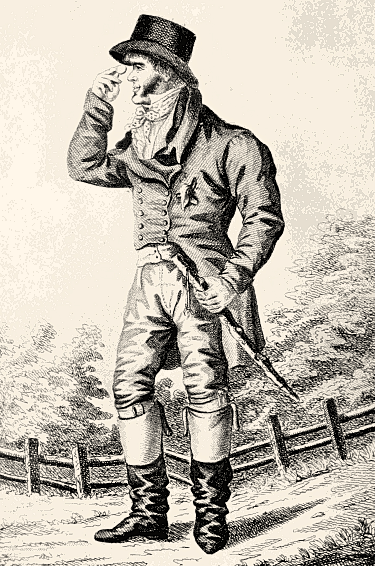
Thomas Pitt was born in Cornwall in 1775. His father, also called Thomas, owned property on Hanover Square, the Square remains one of the posher parts of London today and well suited to a career politician who eventually gained a peerage to the House of Lords.
The young Thomas Pitt was educated at Charterhouse School but education wasn’t his forte and against all advice he jumped ship from the world of education and joined the Royal Navy. He was only 16 when he found himself on board HMS Discovery which had been tasked with exploring America’s Pacific coast.
As it happens it turns out that a life on the ocean ways wasn’t quite Thomas Pitt’s cup of tea either and he was anything but a model sailor. As well as smashing a delicate navigational device he also slept on duty, dabbled in illicit trade and pursued amorous liaisons with native islanders; activities which were strictly forbidden.
The captain of the ship was George Vancouver who is now best remembered for the large Canadian city named in his honour. Captain Vancouver had Pitt flogged and was eventually forced to have him placed in irons.
This didn’t overly upset Thomas Pitt but what did irk him was that he found himself shackled alongside more ‘common’ crewmates… “Don’t they know who I am?” is perhaps what he might have said in the modern day,
Showing continued petulance and inability to cope with orders, Thomas Pitt was discharged whilst docked in Hawaii and had was forced to find his own way home.
By now his father had died died which resulted in the young scallywag now officially being a Lord by the time he finally made it back to London!
For full disclosure, the voyage of Captain Vancouver must have been awful as out of 153 men who departed, who 6 made it back to London in 1795. Captain Vancouver made a home for himself in Petersham, SW London and longed for the quiet life but when Thomas Pitt discovered his former Captain was back in town, this all changed.
Hellbent on revenge, the newly made Lord Pitt sent a letter to his former commanding officer which was packed with insults and challenged him to a duel; a bout which he hoped would “Give him satisfaction for his injuries.”
Like any sensible man wanting a quiet life, George Vancouver refused and so Thomas Pitt vowed to track him down in person, finally succeeding in September 1796 when he cornered his nemesis on Conduit Street, near well-to-do Regents Street.
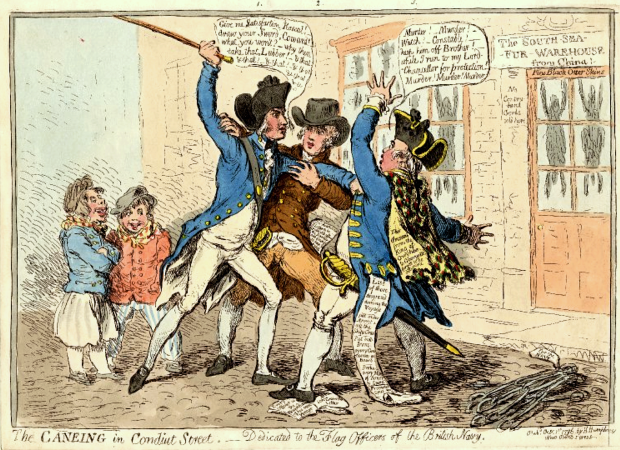
The attack, which became popular gossip in London after being satirised in a cartoon, left an already weakened Vancouver in very poor health and he died shortly thereafter.
Despite being responsible for his death, Thomas Pitt faced no repercussions, largely due to his privileged connections.
Following this encounter, Pitt became more and more involved with on street violence. He was especially fond of roaming the streets in search of potential crooks and troublemakers to rough up; a pastime known as ‘Boxing the Watch’. In one incident he battered a tollgate keeper black and blue after claiming to have been given counterfeit pennies in change- a trifling sum for a man of such wealth. Rather like a government minister claiming for pennies of his expenses today.
If Thomas Pitt wasn’t fearsome enough, he now had a bull-terrier dog that one way or the other (and we can imagine it wasn’t done in a find fashion) became a champion fighting dog. During his career, Trusty endured 104 bouts and remained unbeaten. Pitt later gifted his prized pet to ‘Fighting Jim Belcher’; the celebrated bare-knuckle boxer, explaining that “The only unconquered man was the only fit master for the only unconquered dog.”
Fortunately, it appears Trusty received kinder treatment from Jim and was able to live out his days in the Jolly Brewers, a former Wardour Street pub taken over by the boxer in his retirement.
Perhaps sensing it was time to let things calm down a little and nominally still in the Royal Navy, Thomas Pitt went back on active service and sound rose through he ranks until he was made the commander of HMS Favourite at the age of just 22. Perhaps a doubly controversial choice given it bypassed Camelford’s senior, Charles Peterson.
Although Charles Peterson himself was soon granted command of HMS Perdrix a bitter rivalry festered between the two. and this came to a head when both ships were docked in Antigua and Camelford gave an order to Peterson who, claiming it was not conducive to his own vessel, refused to obey.
This resulted in a tense standoff, during which Camelford asked, “Do you still persist in not obeying my orders?” To which Peterson replied, “Yes my lord. I do persist.”
With that, Camelford stepped forward and shot Peterson dead at point-blank range.
Despite this cold-blooded killing, Camelford was acquitted and when he returned to London in autumn 1798 Thomas Pitt (Lord Camelford) conjured up a plot in which he planned to personally assassinate the nation’s arch enemy, Napoleon Bonaparte.
It seemed an unlikely plot but he packed a brace of pistols, a dagger and a “Letter of introduction to the French” before Lord Camelford caught a night coach to Dover where he chartered a boat, comically claiming he had a collection of fine watches and fabrics he intended to sell to potential French bargain hunters.
As Britain was at war with France during this period any attempt to cross the Channel was punishable by death and as such the boat’s skipper instead took Camelford straight to the authorities who, once again, set the Lord free, this time claiming “His only motive had been to render a service to his country.”
Nevertheless, Camelford was disgusted and resigned from the navy in protest.
Still only in his twenties and now a man of leisure, Lord Camelford once again took to menacing the people of London. In May 1799 he was one of “Several gentleman intoxicated with liquor” who instigated a riot at the Theatre Royal, Drury Lane.
During the brawl, boxes, doors and windows were splintered and smashed and Camelford punched and kicked a man down a flight of stairs. As a result, he had to fork out an impressive £500 in damages- about £22,000 in today’s money!

It was about this time that Lord Camelford employed a servant; a black American named Bill Richmond. Bill had been born a slave on Staten Island, New York but made it to England in 1777 where he rose to become a celebrated bareknuckle fighter.
A known boxing fan, it’s believed Camelford encouraged Bill to teach him some moves and the two men attended a number of prize-fights together. Bill and Lord Camelford could also be seen frequenting London’s many taverns- apparently, the Lord’s favourite past-time was to stir up drunken trouble so he could delight in watching Bill beat innocent people up.

In January 1802 Britain and France announced peace with the signing of the Treaty of Amiens. Properties across London were lit in celebration but Camelford’s residence on the junction of Oxford Street and Park Lane remained resolutely dark; no doubt due to his cynicism at what would turn out to be a short lived peace treaty and the fact he’d been prevented from having a crack at bumping off old Boney himself.
Consequently a mob gathered outside and began breaking Camelford’s windows in protest at his lack of participation in the festivities. Unperturbed, Lord Camelford armed himself with a club and stepped outside to tackle the crowd, beating them back single-handed until they were subdued.
In March 1804 Camelford became embroiled in a spat over a woman with his former friend, Captain Best. After a charged meeting at a coffee house on Oxford Street, Camelford refused to withdraw insulting comments that he’d made.
Only one course of action therefore was left to the two rogues: a duel which was to be held in the grounds of Holland House. Camelford knew his old pal was a far better shot- but backing down would mean cowardice and that was not an option.
When the two turned to fire, Camelford missed but Best’s bullet found its mark, puncturing his foe’s lung. The bullet also destroyed part of Camelford’s spine, paralysing him. With the score settled, Captain Best rushed to his old friend and tried to comfort him.
As the pair gripped hands, Lord Camelford assured the victor, “You have killed me, but I freely forgive you.”
Lord Camelford spent the next three days in agony, during which time he managed to compose his will. In it, he stated that his impending death was his own fault; lost “In a contest of my own seeking” and that nobody was to take proceedings against his antagonist.
On March 10th 1804 Thomas Pitt, the 2nd Lord of Camelford finally succumbed to his injuries. He was 29 years old and had no heir, meaning the Camelford peerage died with him.
Lord Camelford’s body was embalmed and placed in a crypt beneath St Anne’s Church in Soho.
This was intended to be a temporary measure: in his will, Lord Camelford had stated his desire to be buried on the shores of Lake St. Pierre in Switzerland- a place that had been dear to him since childhood- and his body was to lay in St Anne’s only until transport to The Continent could be arranged.
However, whilst stored in the crypt the corpse mysteriously disappeared and has never been since since!
For an even crazier but I think more kind-hearted individual check out John “Mad Jack” Mytton – The craziest man in history! and for a modern day individual then perhaps Mad Jack Churchill might be to your liking!

 Stephen Liddell
Yes, he’d have been at home in today’s government.
LikeLiked by 1 person