Despite walking round London over 300 days a year for 11 years, the amount of times I’ve been there just for fun like a local or tourist could be counted on one hand.
I’ve not been in Buckingham Palace, until last year I’d not been to a West End Show for 16 years nor eaten out there either
This January a combination of wars, post Covid lethargy and a long awaited but repeatedly failed house move, it’s been a bit quieter than usual on the tourist front so I took an executive decision and went to somewhere I’ve been waiting to visit for decades, the National Army Museum.
Much less visited the War Rooms, Imperial War Museum or even RAF Hendon Museum. It’s a bit more for the hard-nut enthusiast and I suspect former service people.
I had gone next door to the Chelsea Pensioners in 1983 on a school trip to meet some old soldiers who had fought in WW1 which I remember very well. The museum certainly wasn’t here then in its present form and though I remember various school days out, I don’t remember coming here before.
There were 2 things i most wanted to see but everything else would be broadly a surprise though me going to a war related museum could be strictly said to be work related.
One of the things that caught my eye was this below.
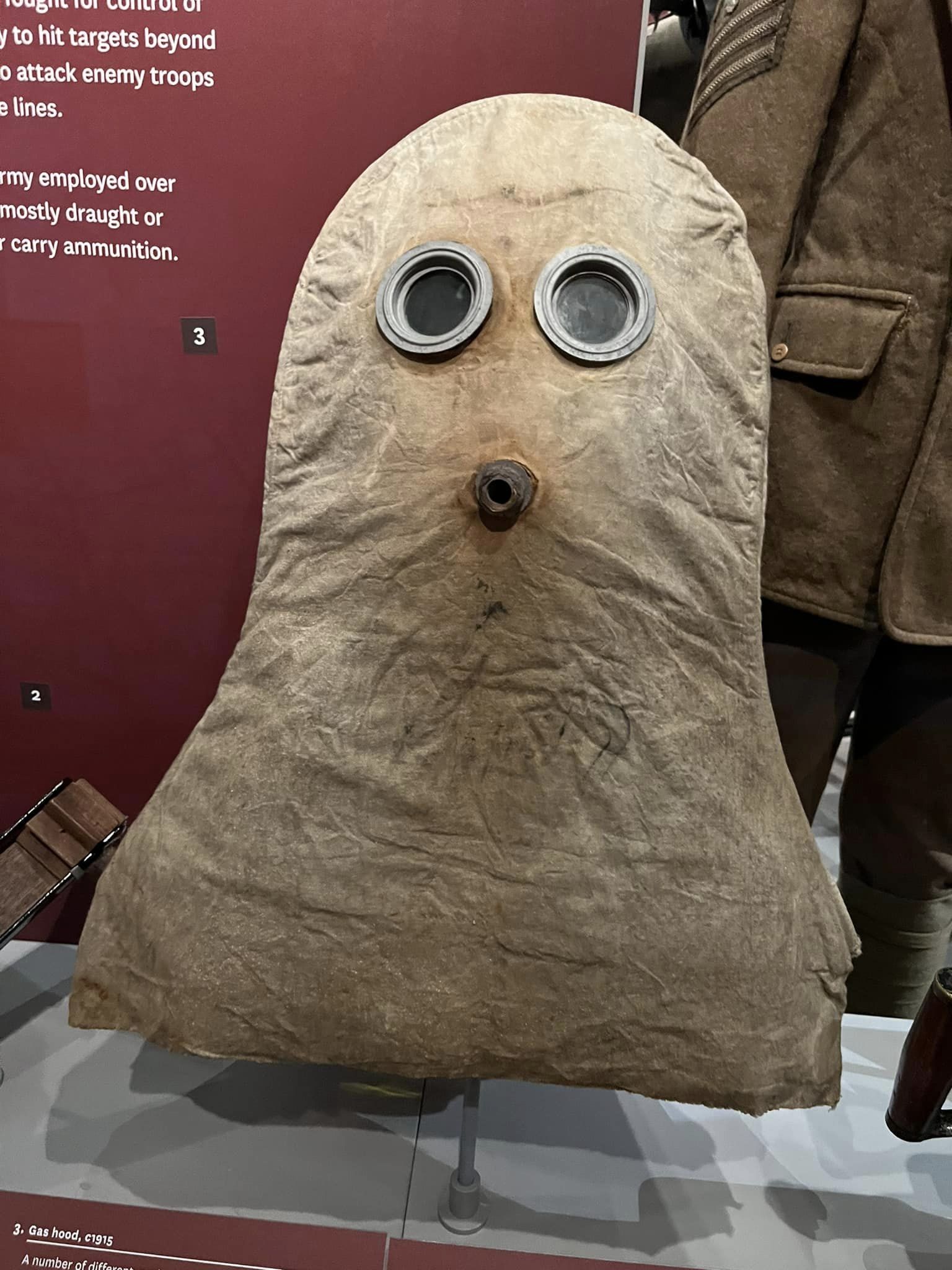
This is an original and very early gas mask from the Western Front in WW1. The use of poisoned gas in WW1 was pioneered by Germany and was a horrible weapon and shock to British, Commonwealth and French soldiers. Sometimes it was a shock to Germans too as if the wind changed direction the very soldiers who released the gas would end up being on the receiving end of it all.
At first there wasn’t really any defence against gas. Soon it was realised that a small degree of protection from some gases could be afforded by breathing through clothing and materials that one had urinated on.
Obviously this was far from ideal and if you’d be happy and confident fighting through poison gas having just wee’d on your underwear or whatever and holding them to your face then you’re braver than even the poor old Fighting Tommies.
It became a priority to protect the soldiers from gas attacks that could either kill, burn, blind and generally lead to an awful and painful malingering end and so these were invented.
Rather than having a separate filter for removing the toxic chemicals as later became the case, they consisted of a gas-permeable hood worn over the head which was treated with chemicals.
The P (or Phenate) Helmet, officially called the Tube Helmet and appeared in July 1915, replacing an even the simpler Hypo Helmet. It featured two mica eyepieces instead of the single visor of its predecessor, and added an exhale valve fed from a metal tube which the wearer held in his mouth. The exhale valve was needed because a double layer of flannel – one treated and one not – was needed because the solution attacked the fabric.
It had flannel layers of cloth-dipped in sodium phenolate and glycerin and protected against chlorine and phosgene, but not against tear gas. Around 9 million were made and they saved countless lives and injuries and is the basis for gas make and breathing apparatus used right up to the modern day.
That being said, I still wouldn’t be keen fighting in one but I guess hugely better than what came before it.
There are lots of WW1 posts on my blog over the last decade or more but you may also like to have a look at my first ever book published by the leading Independent London publishers.


 Stephen Liddell
Oh the cruelties we inflict on each other 😦
LikeLiked by 1 person
Yes, as if life wasn’t bad enough running into machine gun fire through barbed wire as artillery shells wasn’t bad enough 😦
LikeLike