One of the eras of history I most enjoy is that bit of British history after the Romans and before the arrival of those pesky Normans. When the land was split between numerous kingdoms who battled for control and eventual a land of many kingdoms became one of few.
It seems at least some of these old kingdoms had some connection or foundation to life before the Romans in the way that places that were occupied by the Soviet Union found their old identities afterwards.
One such kingdom one that I was born within, or at least I would have been if it was still here today. Rheged. Not many people know of it and more broadly speaking I think it is a shame our local histories are taught very widely at school. It’s all Romans or Tudors or Industrial Revolution or World Wars and Suffragettes. All very fascinating and perhaps unifying stuff. maybe our old kingdoms aren’t taught as it’s not a very unifying thing to do, officialdom doesn’t even seem to like Counties despite their often ancient histories going back thousands of years.
Anyway back to Rheged. There isn’t that much physical evidence for Rheged any more but one rather prominent, if from London remote, spot is in the Lake District.
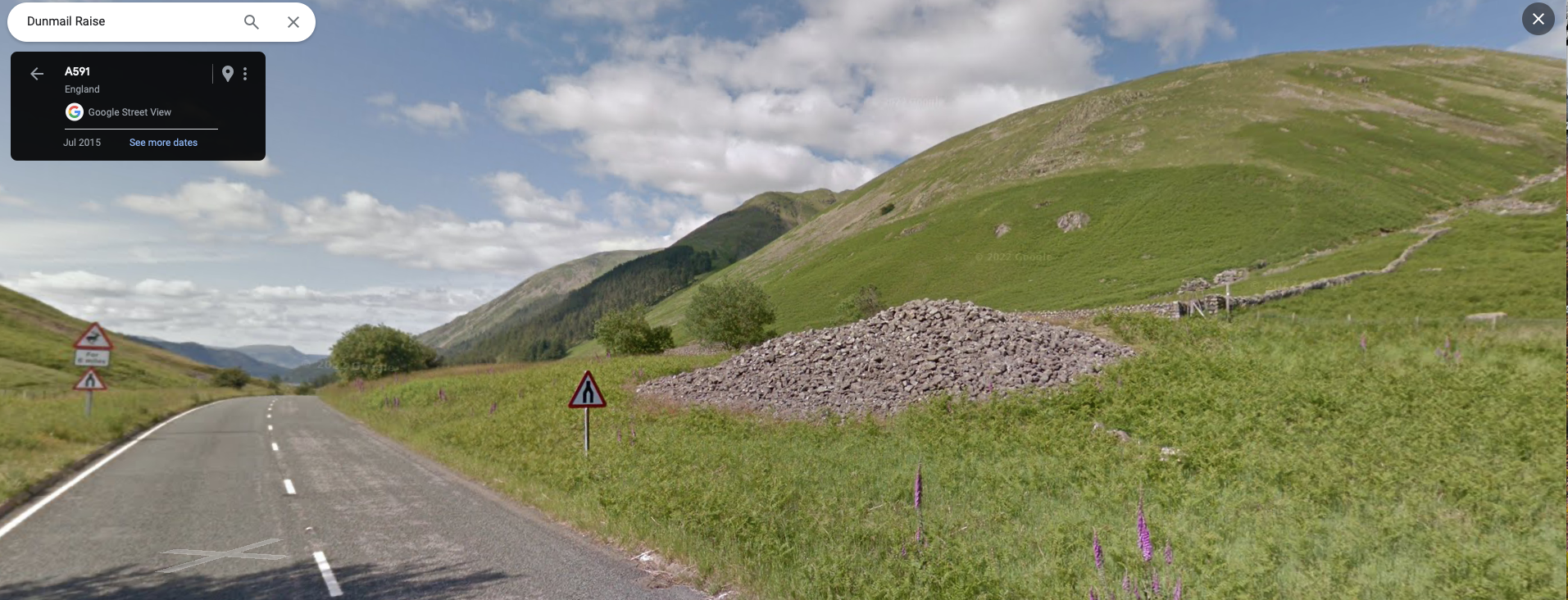
One of my favourite roads in Britain and one that has been voted once or twice as the best road in the country is the A591. Anyone who has travelled along the A591 near Grasmere may have you might’ve noticed a pile of stones at the short section of dual carriageway. You might not have thought anything of this, however there is more to this pile of stones than meets the eye as this is said to mark where an ancient battle took place.
The battle that took place here was between Dyfnwal (Dunmail) ab Owain, King of Rheged, the last king of Cumbria, and the Anglo-Saxon King Edmund, grandson to Alfred the Great and happened around 945AD. It was a battle over land in what is now Cumbria.
At that time the Celtic language was undergoing rapid change, the pre-Roman ‘Brigant’ which is a rather famous grouping seems to have become ‘Breged’ and then Rheged.
The modern county of Cumbria is really the heart of Rheged, and was once known by the old the British word ‘cymri’ which means ‘men of the same area or country. In fact the Welsh word for Wales is Cymru and has a pretty much similar origin. The Anglo-Saxons had another name for them ‘Wealas’- the foreigners which became Wales.

Legend tells that the stones were raised above the body of the slain King Dyfnwal ab Owain. It has also been suggested that the stones are ‘soul stones’; before battle, each person laid down a stone and after the battle they picked up a stone, so the pile of stones could represent the slain. It was also used to determine the boundary between Cumberland and Westmorland. (Incidentally the county of Westmorland was revived at the end of 2023!!)
Dyfnwal was from a long line of kings of Strathclyde/Cumbria. His father Owain ‘The Giant’ is believed to be buried at the Giants Garve at St.Andrews Church in Penrith. Owain the giant fought at the bloody Battle of Brunanburh against the victorious Saxon King Athelstan in 937AD. Owain and King Constantine of Scotland were allies during Brunanburh.
Malcolm, son of Constantine, switched sides and during the brutal and bloody Battle of Dunmail fought alongside Edmund and the Saxons. Dyfnwal Ab Owain was slain and his sons were mutilated. Dyfnwal’s crown was said to have been thrown into Grisdale Tarn, still lying at the bottom of the tarn to this day. This element could be myth as the value would be too high for the victor to throw away.
It’s not completely understood why the Scots betrayed King Dunmail and joined with the Anglo-Saxon ‘English’. It is a fair assumption that a secret agreement had been made before the battle which would allow for the conquest of Rheged and the small kingdom divided between the bigger ones. Almost a Dark Age Molotov–Ribbentrop Pact!
As to what happened next, in the tenth century, after the power of Northumbria was destroyed by the Vikings, large areas west of the Pennines fell peacefully under the control of the Kingdom of Strathclyde, with Leeds referred to as being on the border between the Britons and the Viking Kingdom of York. Cumbria came under Scottish rule until 1072 when England’s second Norman King, William II, ‘Rufus’ took Carlisle, settling the town with his Norman followers. He found the old Roman fortress there in ruins and established Carlisle Castle to guard the frontier in 1092. The town was retaken by David I, King of Scots in 1136. Cumbria was again returned to English sovereignty in 1157 by Malcolm IV of Scotland, known as ‘the Maiden’.
What about the culture of Rheged? Obviously the landscapes of the Lake District and uniquely beautiful and world renowned and like other parts of Britain retains its unique traditions, foods etc
Sadly the language of Cumbria, Cumbric was eventually replaced by English and its Scottish variant – Lowland Scots. The Scottish lowland accent derives from Cumbric. Although now an extinct language, some farmers in Cumbria still count sheep using terms that derive from Cumbric – eg Yan, Tan, Tethera, Methera, Pimp compared to Old Welsh “Un, Dou, Tri, Petwar, Pimp”.
Several place names in Cumbria and SW Scotland are thought to have Cumbric origins. Lanark, deriving from the equivalent of the Welsh llannerch ‘a glade, clearing’, Glasgow, from words equivalent to Welsh glas gau ‘green hollow’ and Penrith, Cumbria, meaning ‘chief ford’ (Welsh pen ‘head; chief’ and rhyd ‘ford’).
Most obviously though are the names of the mountains and fells. The names of such familiar Lake District fells as Blencathra and Helvellyn derive from the old language. For some years Blencathra was known as Saddleback but as with many places, the local language or at least words have reclaimed their rightful usage.
The River Derwent and Derwent Water may derive from the Celtic dur gwin – “clear water”, although other claims have been made for a derivation from the Celtic word for oak tree – dar or derwen.
There are lots of local dialect words and phrases too that would mean nothing to people outside the area. I myself still use the word ‘Larl’ which means little or small.
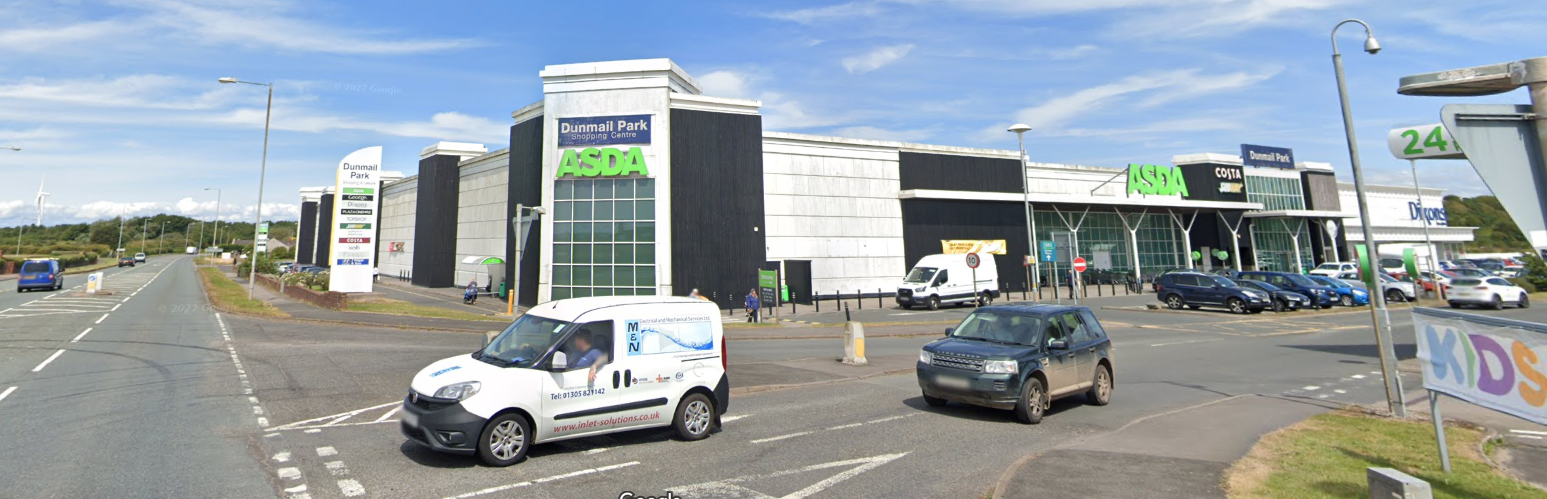
If clambering over mountain passes isn’t your thing then perhaps you can pay tribute to King Dunmail at this out of town retail park just a mile or so from where my grandparents lived.
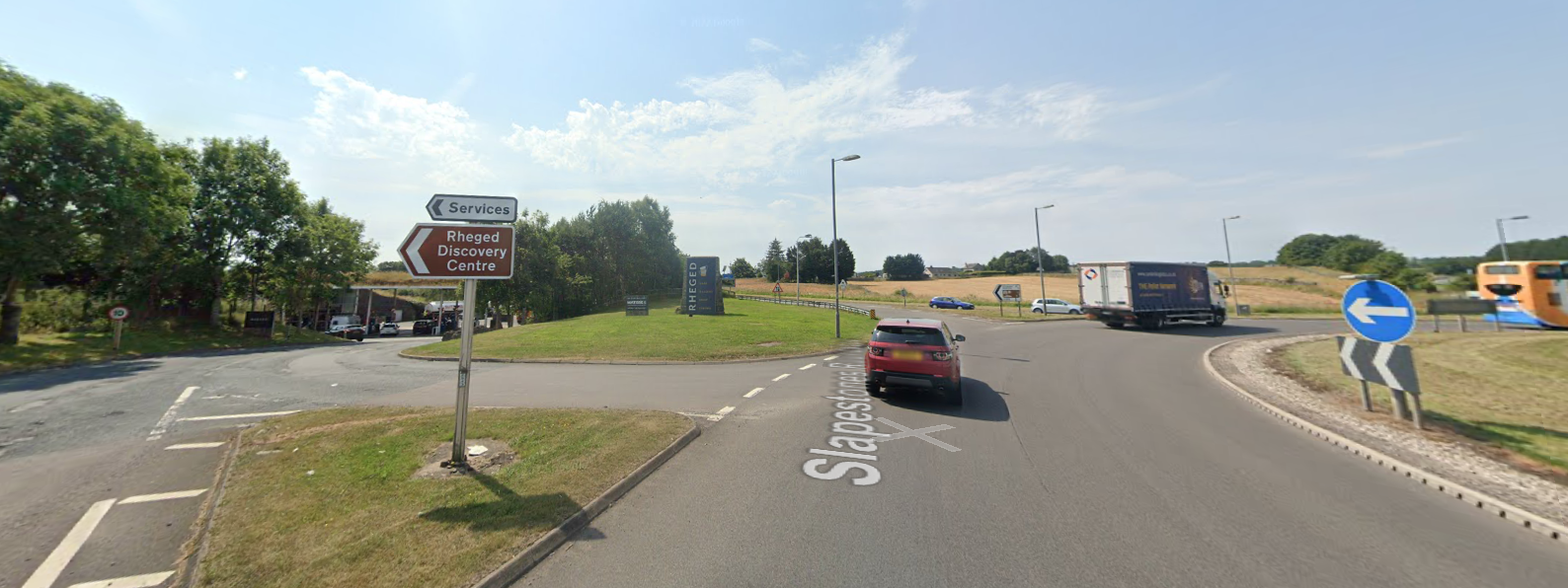
Whereas on the eastern side of his kingdom is Rheged Discovery Park which is a local cultural centre, one of many places locally I drove by many times in my childhood but could never get my father to show enough interest to stop the car… or indeed take any interest whatsoever!

 Stephen Liddell
Though not the main idea in the post, this line caught my attention: “maybe our old kingdoms aren’t taught as it’s not a very unifying thing to do, officialdom doesn’t even seem to like Counties.”
The central government has the most money and spends the most on “patriotic” efforts. States are often viewed as opponents if they do not toe the line.
I am not sure where I am going with this, but this is pushing us towards top-down governance, the opposite of good governance in my view.
LikeLiked by 1 person
Hello! Yes I was also thinking places near to where you live and also Russia and China and several in Europe too such as in Spain. Making up a generic identity from a capital city might make it easier to make money or govern centrally but I agree its not good. In the U.K. a huge amount of the most popular and famous places are those that retain a local identity (even if not as strong as centuries ago). People know of and want to visit Cornwall and Devon and Yorkshire and Northumberland because they aren’t just the same. To pretend Northumberland for example with his desolate moors and ancient battles with Scots and Vikings and Roman walls and just a few dozen people per square km is the same in any way as London is wrong.
LikeLiked by 1 person
Very Interesting, you should do more online history lessons
LikeLiked by 1 person
yes yes yes! Another well written and full of information, post. Im sharing these with my grandson. I am home schooling him and use lots of your writings and pictures for history. He wants to go to England so bad, Maybe one day you’ll get to give Aiden Liddell a tour!
LikeLiked by 1 person
Thankyou, you’re welcome. That would be really neat!
LikeLike
Nice piece. Do you know where Dunos fits in? Can’t find anything online – was it absorbed into Rheged or Elmet maybe? (I mentioned Elmet towards the end of this piece, but maybe I got that wrong, and I should have said Dunos?) https://hillandmountain.blog/2023/03/10/malham-and-moor/
LikeLike