Originally the Lord Mayor of the City of London would use their own home or livery hall in their elected position deafening up the City’s governmental, judicial and civic functions. After the Great Fire of London, the idea arose that the Lord Mayors should have their very own official home.
It took almost a century before the idea came to fruition and Mansion House was completed in 1758 with the first Lord Mayor to take up residence there being Sir Sir Crispin Gascoigne.
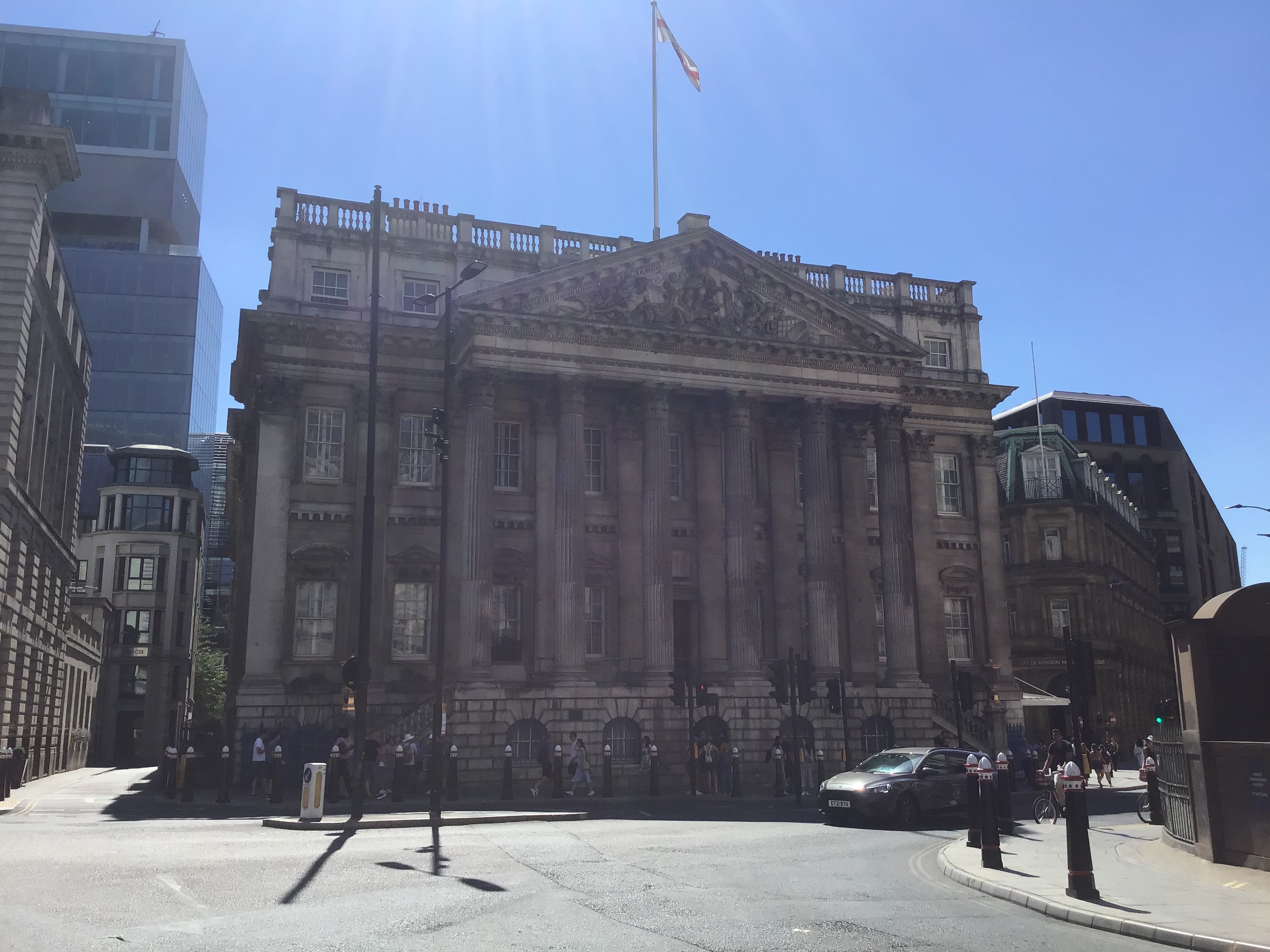
I think it is perhaps the most imposing building in the Square Mile. Wonderfully Palladian in style with a grand temple portico at the front approached by flights of steps each side. Sitting off Bank Junction and almost opposite the in someways even more spectacular Royal Exchange Building and the Bank of England, you can see why this area has been the centre of power since Roman times even though it is a spot that I’d guess over 99% of tourists never visit.
Entertaining rooms were built on the first and second floors. The first floor originally had a roofless courtyard and the great Egyptian Hall.
The second floor has a ballroom and private apartments of the Lord Mayor and family. The third and fourth floors contain meeting rooms and staff rooms. The cellars have storage space and once held prisoners’ cells, reflecting the former use of the Mansion House as the Lord Mayor’s Court.
Later on the main entrance was moved to the side on Walbrook Street. Partly due to road improvement works at the front but also to afford the Lord Mayor a little privacy so they could could come and go without being in the full view of the general public.
The entrance is now used to bring the Lord Mayor’s guests into the vaulted areas on the ground floor ascending to the Salon.
One of the most impressive rooms inside is the Salon. Originally designed to be a roofless courtyard, it was covered almost as soon as the Mansion House was opened by George Dance the Younger. It provides a large reception area under a stunning row of crystal chandeliers.
Originally the Mansion House shared the chandeliers to light banquets with the Guildhall, and they were moved back and forth at great risk. In the late 1700s the inevitable happened as they were bringing the chandeliers back from Guildhall: a number of chandeliers were broken. The Court of Alderman were left with little choice but to allow the Mansion House to be kitted out with its very own and very splendid chandeliers.
Each piece contains more than 30% lead, to deepen the sparkle and colour so they must be incredibly heavy. The chandeliers are cleaned and re-pinned on a regular basis. The skilled craftsmen, who undertake this work, say that the Mansion House chandeliers are unmatched.
Other notable rooms include an interlinking pair of drawingsrooms with a scheme of decoration inspired by descriptions from the mid-19th century, when the suite of chairs and sofas known as the Nile Suite (c.1803 to commemorate Nelson’s sea victories) were first used to furnish these capacious, stately rooms.
Directly opposite the Drawing Rooms across the floor of the Salon is the Long Parlour. This elegant room the is primarily used for business meetings and dinners. The present furnishings and decoration are designed to recall the mid-18th century character of the room.
Perhaps the grandest room of all is the Egyptian Hall. In one of those weirdly British things, the Egyptian Hall has no visible connections with Egypt. It should actually be known as the Roman Hall, as it is based on designs by the classical Roman architect Vitruvius of Roman buildings in Egypt, with giant columns supporting a narrower attic area.
The walls of the room are decorated with statues of ancient English kings and from what I could tell, classical gods and date 1854-64. There are also two fantastic stained glass windows from 1868.
To top it all off is the Old Ballroom which is used for meetings, conferences and dinners.
In short Mansion House is a palace in everything but name and a fitting home for the Lord Mayor of London who for one year only, heads up the City of London Corporation.
If you want to know why the Lord Mayor of the City of London is the top authority in the City, even above the King then take a look at https://stephenliddell.co.uk/2022/12/19/the-charter-of-king-william-i-the-conqueror-to-the-city-of-london/

 Stephen Liddell