Spending all day in London, it’s always been clear to me that it doesn’t just have its own heat-island climate (https://stephenliddell.co.uk/2018/01/27/busting-the-myth-of-london-being-a-rainy-city/) In fact London has multiple different microclimates and I encounter several every day. Some places it is always much warmer than others. Some places seem perpetually cooler and windier and it rains more at the end of my back garden than it does in the front garden!
More scientific than my musings, a new heatmap has revealed which London boroughs trap the most heat and, unsurprisingly, it’s the areas with the fewest green spaces and trees that are the warmest.
The map, created by climate organisation Friends of the Earth and map experts TerraSulis, is the first time the cooling ability of green space and trees in urban areas has been properly visualised.
Overbuilt up district of central London boroughs like the City of London and Tower Hamlets were found to be the hottest, with almost no ways of cooling off. Neighbourhoods like Camden, Westminster and Greenwich, however, benefit from being close to Hyde Park, Primrose Hill and Woolwich Common. Charlton Park and Woolwich Common were some of the coolest areas, being up to 5C (9 degrees Fahrenheit) or an average of 3.5 degrees C cooler than London’s hottest areas.
During last year’s hottest day on record the climate organisation found that inner-city areas with no trees can be up to five degrees hotter than leafy areas. London was one of five UK cities that were researched by Friends of the Earth for cooling properties.
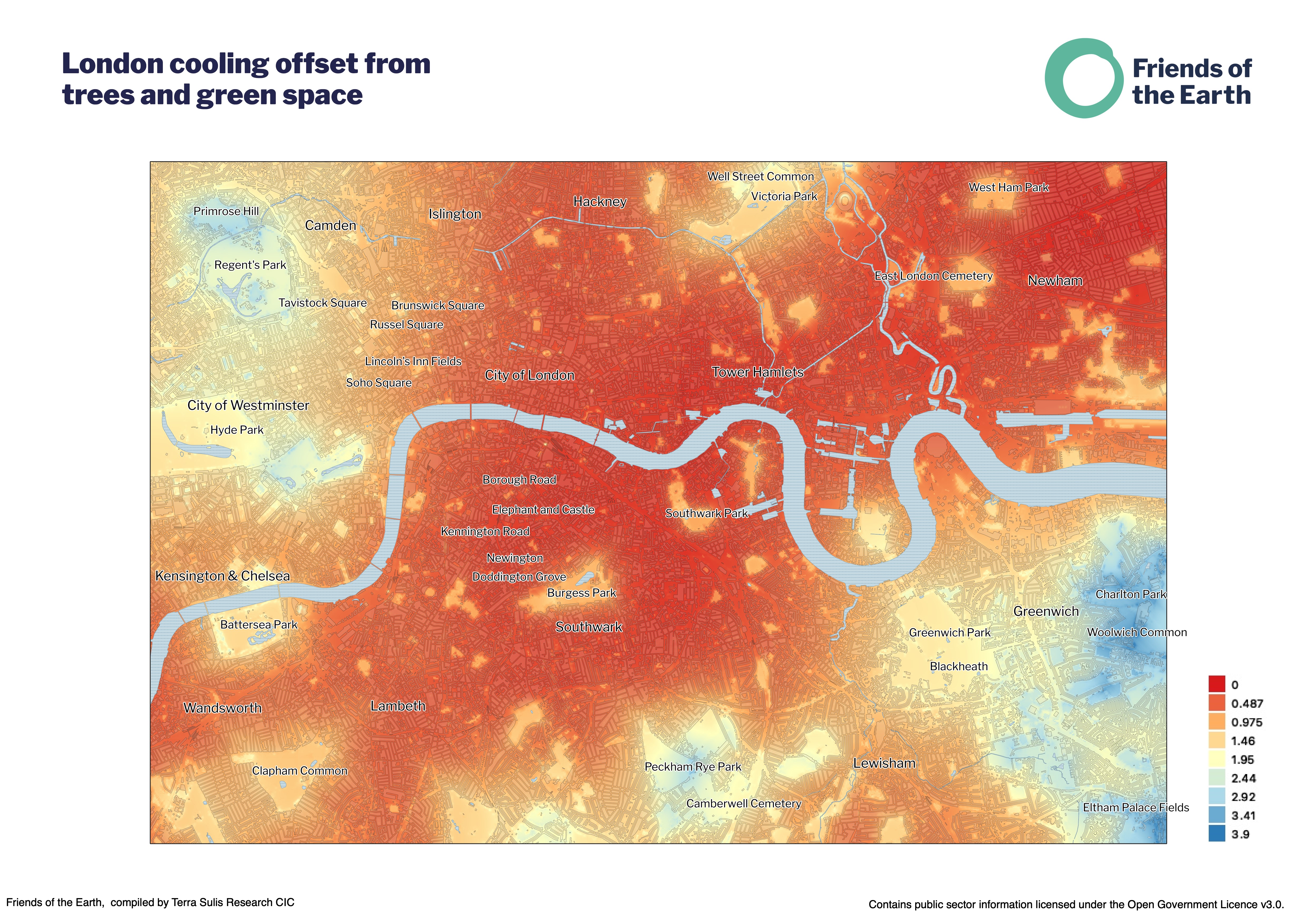
Mike Childs, head of science, policy and research at Friends of the Earth, said: ‘We know that extreme weather, including heatwaves, is becoming more frequent and severe due to the climate crisis. But not everyone is affected equally, with the most marginalised communities the hardest hit in the UK and overseas.
‘Boosting tree numbers is such a clear win for our communities and our planet, not just because of their ability to cool urban areas, but because they capture planet-warming carbon too.
‘This should be prioritised alongside a rapid programme of council-led, street-by-street insulation, which helps keep homes cool in the summer just as much as it keeps them warmer in winter.’
Obviously I’ve written lots of posts on London and it’s secret gardens, being the first national park city in the world and much more besides but for an ld but fascinating post about trees in Africa then why not take a peek at The Man Who Planted Trees and The Green Wall of Africa
Four other large cities were surveyed (Birmingham, Bristol, Manchester and Newcastle Upon Tyne) with similar results.
If you’re visiting London and the U.K. and you love history as much as you do the planet then come on a private tour with me at Ye Olde England Tours. We are verified by Green Tourism so a great day out to remember needn’t cost the Earth!



It is clearly a low-hanging fruit. Equally, it is not a new solution. At least in India I have heard of it being at least a partial solution for several decades, with major tree plantation drives carried out with great fanfare. Also, tree saplings are not difficult to come by. In fact, they are often available for free. So, why are we not fully treed up by now?
LikeLiked by 1 person
Yes exactly. Instead of having patriotic days, once a year every person in every country should plant a tree. I remember in the 90’s there was some very rich Emirati Sheik who was planting lots of trees and even in a decade or so he had locally improved the desert climate. Even Egypt used to have lots of trees in the time of the Ancient Egyptians. They also help a lot with flooding and erosion too.
LikeLike
This is the simplest way to cool all cities. Trees, trees 🌲 TREES 🌲 TREES!
LikeLike