At noon on the 13th October 1741, the improvised schooner, now named the Speedwell, got under sail with the cutter and barge in company. Captain David Cheap refused to go, and to the relief of the mutineers he agreed to be left behind with two marines who were earlier shunned for stealing food. The mutineers expected Cheap to die on the island, making their arrival in England much easier to explain. Bulkley assumed this by writing in his journal that day, “[T]his was the last I ever saw of the captain”. In the event, both men would make it back to England alive to tell their version of events, Cheap some two years after Bulkley.
Initially the voyage got off to a bad start. After repeatedly splitting sails, the barge was sent back to the island, where there were additional stores.[Two midshipmen, John Byron and Alexander Campbell, who had been tricked into thinking Cheap would be taken home with them, quietly slipped aboard the barge and were among the nine who returned. When Bulkley realised they were onboard he tried to get them to return but the barge set sail quickly and rounded the point of land whilst Speedwell was at anchor. Once back at the island, the barge party was greeted by Cheap, who was delighted to hear of their wish to remain with him. By the time Bulkley sailed back in search of the barge and its men, all had disappeared.
Speedwell and the cutter turned around and sailed south. The journey was arduous and food was in very short supply. On the 3rd November the cutter parted company; this was serious as she was needed for inshore foraging work. By now Bulkley was despairing of the men aboard the schooner; most were in the advanced stages of starvation, exposed in a desperately cold, open boat, and had lapsed into apathy. Some days later they had good news, sighting the cutter and rejoining it. Soon after, at night, she broke loose from her consort’s tow line and was wrecked on the coast. Of the eighty-one men who had departed about two weeks before, ten had already perished.
As food began to run out, the situation became desperate. Ten men were picked out and forced to sign a paper consenting to being cast ashore on the uninhabited, frozen, bog-ridden southern coast of Chile, a virtual death sentence. Sixty men remained aboard Speedwell. Eventually the schooner entered the Strait of Magellan, in monstrous seas which threatened the boat with every swell. Men were dying from starvation regularly. Some days after exiting the Strait, the boat moved closer to land in order to take in water and hunt for food. Later, as the last of their supplies were being taken on board, Bulkley made sail, abandoning eight men on the desolate shore 300 miles south of Buenos Aires. For the second time he would abandon men to a seemingly certain death, only to confront some of them back in England years later; three of the party he left behind, after much exertion, made it back to England alive. Only thirty-three men remained aboard Speedwell.
Eventually, and after a brief stop at a Portuguese outpost on the River Plate, where the crew were fleeced by the locals for meagre provisions and cheated by a priest who disappeared with their fowling pieces (shotguns) on the promise of returning with game, Speedwell set sail once more. On 28 January 1742, it sighted Rio Grande, after a journey of over two thousand miles in an open boat over fifteen weeks. Of the eighty-one men who set off from the island, thirty arrived at Rio in a desperate condition.
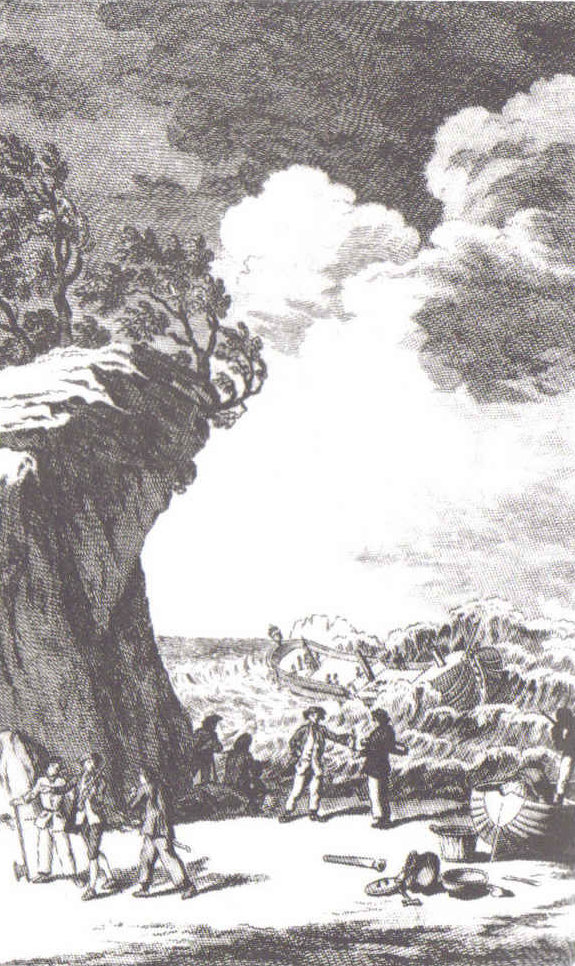
Meanwhile back on Wager Island, 20 men remained after the departure of Speedwell. Poor weather during October and November continued. One man died of exposure after being marooned for three days on a rock for stealing food. By December and the summer solstice, it was decided to launch the barge and the yawl and skirt up the coast 300 miles to an inhabited part of Chile. During bad weather, the yawl was overturned and lost, with the quartermaster drowned.
There was not enough room for everyone in the barge, and four of the most helpless men, all marines, were left on the shore to fend for themselves. In his account, Campbell describes events thus:
“The loss of the yawl was a great misfortune to us who belonged to her (being seven in number) all our clothes, arms, etc. being lost with her. As the barge was not capable of carrying both us and her own company, being in all seventeen men, it was determined to leave four of the Marines on this desolate place. This was a melancholy thing, but necessity compelled us to it. And as we were obliged to leave some behind us, the marines were fixed on, as not being of any service on board. What made the case of these poor men the more deplorable, was the place being destitute of seal, shellfish, or anything they could possibly live upon. The captain left them arms, ammunition, a frying pan, and several other necessaries.”
Fourteen men were now left, all in the barge. After repeated failed attempts to round the headland, they decided to return to the island and give up all hope of escape. The four stranded marines were looked for but had disappeared. Two months after leaving the island, Cheap’s group returned. The thirteen survivors were close to death, and one man died of starvation shortly after arriving.
Back at the island Cheap’s health was observed to deteriorate markedly, with his legs swelling to twice their normal size, and he also attracted criticism in Byron’s subsequent narrative for taking more food than the others but doing less work. Fifteen days after returning to the island, the men were visited by a party of indigenous Chono nomads led by Martín Olleta who were astonished to find castaways there. After some negotiation, with the surgeon speaking halted Spanish, the Chono agreed to guide Cheap’s group to a small Spanish settlement up the coast, using an overland route to avoid the peninsula. The castaways traded the barge for the journey. Iron was highly valued by the Chono as this metal was scarce even in the Spanish settlements further north.
Martín Olleta led the survivors through an unusual route across Presidente Ríos Lake in the Taitao Peninsula, avoiding the common route through the San Tadeo River and San Rafael Lake. Byron gives a detailed account of the journey to the Spanish village of Castro in the Chiloé Archipelago, as does Alexander Campbell. The ordeal took four months, during which another ten men died of starvation, exhaustion and fatigue. Marine Lieutenant Hamilton, Midshipmen Byron and Campbell, and Captain Cheap were the only survivors. Before handing over the English to Spanish authorities, Olleta’s party stopped somewhere south of Chiloé Island to hide all iron objects, likely to avoid having them confiscated. Scholar Ximena Urbina conjectures that Olleta must have lived close to the Spanish and heard from other natives of the wreckage; thus the rescue was not by chance but an enterprise done with prior knowledge of the Spanish interest in foreigners and of the valuable loot to be found at the wreckage.
My next post will detail on how the various surviving groups made it back to London.

 Stephen Liddell