If you have read my last blog post on the Voyager of HMS Wager, it might make sense to do so before ploughing on below.

Wager struck rocks on the coast of a small, uninhabited island. Some of the crew broke into the spirit room and got drunk, armed themselves, and began looting, dressing up in officers’ clothes and fighting,[while 140 other men and officers took to the boats and made it safely to shore. Their prospects were desperate, as they were shipwrecked far into the southern latitudes at the start of winter with little food on a desolate island without resources to sustain them. The crew were dangerously divided, with many blaming Cheap for their predicament. On 15 May, the ship bilged (the bottom of the hull broke open!) amidships, and many of the drunken crew drowned. The only crew members left aboard were boatswain John King, a rebellious and difficult individual, and a few of his followers.
With the crew of HMS Wager frightened at their situation and angry with Captain David Cheap, dissent and insubordination grew. King fired a four-pounder cannon from Wagerat the captain’s hut to induce someone to collect him and his mates once they began to fear for their safety on the wreck.
The crew knew that they were in danger of harsh justice if they mutinied, so they worked to build a story to justify their actions. Full mutiny would likely not have occurred had Captain Cheap agreed to a plan of escape devised by Bulkley, who had the confidence of most men. He proposed that Cummins, the ship’s carpenter, would lengthen the longboat and convert it into a schooner which could accommodate more men. They would make their way home via the Strait of Magellan to either Brazil or the British West Indies, and then home to England. The smaller barge and cutter would accompany the schooner and be important for inshore foraging work along their journey. Bulkley was skillful enough to give the plan a chance of success. Despite much prevarication, Cheap would not agree to Bulkley’s plan. He preferred to head north and try to catch up with Anson’s squadron.
Captain David Cheap was in a difficult predicament. By being shipwrecked he would automatically be subject to court martial, and he could be thrown out of the navy and into a lifetime of poverty and isolation, at best. At worst, he could be found guilty of cowardice and executed by firing squad, as demonstrated a few years later by the 1757 execution of Admiral John Byng. Cheap wanted to head north along the coast to rendezvous with Anson at Valdivia. His warrant officers had warned him against some of his actions, which would reflect badly on him when the Admiralty investigated the loss of Wager.
There was also a legal issue as it was widely thought in the event of a shipwreck or the destruction of a vessel that the Captain and officers no longer had any authority over the now ‘unemployed’ sailors.
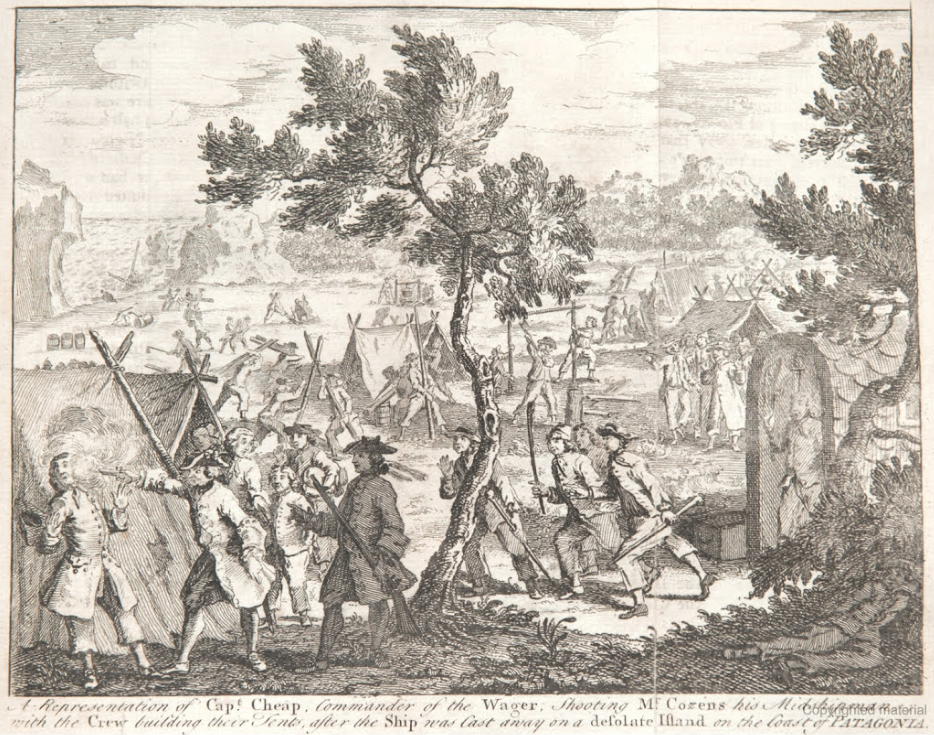
The mutineers later justified their actions based on other events, including Cheap’s shooting of a midshipman named Cozens. Cheap heard an altercation outside his tent, came out in a rage, and shot Cozens in the face at point blank range without any warning. This incident further raised tensions, as Cheap refused to allow medical aid for Cozens, who took ten days to die of his wound.
There were other serious problems too, the food situation was increasingly dire after a few weeks. Fights were common and there was at least one suspected murder for relatively meagre provisions. The dying castaways experienced a miracle when the Kawésqar, a native people with experience in fishing and foraging, arrived and helped to supply food. It was a brief reprieve. The bad behaviour of the sailors soon sent their saviours running, and the remainder gradually turned on one another.
Despite all of this, Cummins continued modifying the boats for an undetermined plan of escape, and outright mutiny remained only a possibility so long as his work continued. Once the schooner was ready, however, events happened quickly. Bulkley set the wheels in motion by drafting the following letter for Cheap to sign:
Whereas upon a General Consultation, it has been agreed to go from this Place through the Streights of Magellan, for the coast of Brazil, in our way for England: We do, notwithstanding, find the People separating into Parties, which must consequently end in the Destruction of the whole Body; and as also there have been great robberies committed on the Stores and every Thing is now at a Stand; therefore, to prevent all future Frauds and Animosoties, we are unanimously agreed to proceed as above-mentioned.
Baynes was presented with the letter to read, after which he said:
I cannot suppose the Captain will refuse the signing of it; but he is so self-willed, the best step we can take, is to put him under arrest for the killing of Mr. Cozens. In this case I will, with your approbation, assume command. Then our affairs will be concluded to the satisfaction of the whole company, without being any longer liable to the obstruction they now meet from the Captain’s perverseness and chicanery.
Captain Cheap refused to sign Bulkley’s letter. Armed seamen entered his hut on the 9th October and bound him, claiming that he was now their prisoner and they were taking him to England for trial for Cozens’ murder. Lieutenant Hamilton of the Royal Marines was also confined, the mutineers fearing his resistance to their plan. Cheap was completely taken aback, having no real idea how far things had gone. He said to Lieutenant Baynes, “Well ‘Captain’ Baynes! You will doubtless be called to account for this hereafter.
We’ll rejoin the crew of the Wager in the next post but for a similarly against all the odds tale then why not read I Am The Army – The Incredible Story of William Brydon.

 Stephen Liddell
