Not quite Halloween related, heaven knows I have written enough of them over the last 10 years but something still a little bit gory to get our fangs into. I’m a great one for unfortunate deaths in times gone by, it inspired me to write 101 Most Horrible Tortures In History. For some reason this post rather reminds me of the unfortunate early cricket game at Tilbury. When Cricket FairPlay and sportsmanship were hit for SIX at Tilbury Fortress
Today it is known as the beautiful game, but in Tudor times football was a deadly pastime. Evern since Jurgen Klinsmann introduced diving as an art form when the Premier League was founded, I like most others have been disgusted at the diving, feigning or injuries and general unsporting attitude. If I can get pushed under a tube train and give a 5 hour tour with a fractured leg then a big tough well paid footballer should be able to cope with someone breathing on them.
In the 16th century more people died playing it than sword-fighting, a historian has discovered and although the modern game was born in the late 19th century, the origins of football go back centuries.
The first recorded game took place in London in 1170 and was recorded by William FitzStephen. Matches would spring up on an ad-hoc basis across the country. The violent fixtures would go on for hours if not days and deaths were not uncommon.
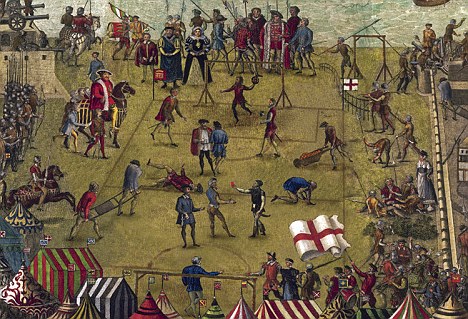
Some historians have said the sport was first started as a war game and was often played between villages. It is believed that although it was called football, players could pick the ball up and run with it as well as kick it.
Edward II banned the sport in 1314 because he was concerned men were more interested in it than archery. However, it was ignored and prosecutions were rare so the game continued to flourish and despite repeated attempts to crackdown on the sport the game was never killed off.
Seven footballers were killed after clashes in English villages between 1500 and 1575, new research has revealed. Records show the sport was more violent with physical clashes and contact resulting in people being badly injured and accidentally crushed. The game involved dozens of players competing against one another. Players would clash violently in a sport that was similar in style to Rugby.
As it turns out a significant proportion of all deaths in the 16th century came from sport and other recreational actives.
Football was the second most dangerous sport during the period – beaten only by the death toll of 56 from archery. It was followed in joint third place by wrestling, sword-fighting and – oddly – bell ringing, which each caused three deaths.
Other notably dangerous sports included hammer throwing, which caused two deaths, and quoits, which caused one. Quiots is a northern game which involves throwing a ring towards a set target.
In one of the record uncovered, from February 20, 1523 in Allerston, North Yorkshire, said a football player died as he challenged for the ball.
The entry read: ‘John Langbern of Allerston was playing football with Roger Bridkirk of Allerston, labourer, and many others.
‘They were running after a certain ball called the “foteball”, no malice being between them, and both came to the ball at once and fell to the ground.
‘Roger fell on top of John and crushed his body by misfortune, so that John immediately died.’
Of the seven footballers to die while playing the game, two men were accidentally stabbed with a knife in the process of tackling an opponent. Others suffered internal injuries from hefty falls while one player died from a broken leg.
On February 20, 1508 Thomas Bryan was playing in Yeovilton, Somerset, and had his knife hanging from his belt and was killed. The record states: ‘He fell onto it by misfortune, it struck him in the body and he immediately died. So he killed himself by misfortune.’
If like me you’re wondering how people might die whilst ringing church bells then this will reveal all. In a bizarre death, a man was killed after being pulled into the air as he rang a bell before plunging to the floor.
In an entry from Preston, Suffolk, on August 22, 1568 it was recorded: ‘Adam Strutt was in the bell-tower of the church.
‘He rang “the thirde bell”, pulling a rope attached to the wheel of the bell, but the rope caught round his feet and pulled him seven feet off the ground, from which height he fell head-first onto the paved floor of the bell-tower.
‘He languished until 6pm on August 23, when he died.
‘The bell, rope and wheel, which remain in custody of inhabitants of Preston and are worth 13s 4d, were the cause of the accident.’
Perhaps unsurprisingly, wrestling was also a dangerous sport with participants dying from accidental but predictable wounds.
In one bizarre accident, on October 31, 1518, a John Homler was playing and wrestling in the churchyard at Skeckling near Burstwick in Holderness, Easty Yorks, with Thomas Tenyson and William Lamrose.
Records show: ‘Stephen Kayngham of Skeckling, husbandman, came to them and said that he was a manly man who could throw all three of them over the churchyard wall.
‘John Homler said that he could not. Stephen Kayngham took John Homler and without malice or ill-will took him and put him over the churchyard wall.
‘John Homler fell to the ground and his knife, which was sticking out of its sheath, by great misfortune pierced a vein under the elbow in his right arm to the depth of an inch and his blood flowed out copiously.’
Archery was the sport that led to most deaths.
An entry on June 2, 1542 in Lowick, Northamptonshire, states: ‘Alexander Godbye sat on the churchyard wall watching archers shooting at targets next to the wall.
‘They warned him several times to get down lest he get hit, but he would not.
‘John Fryssby’s arrow struck him on the left side of the head and he languished until 12 June, when he died.’
That all brings us back to the now very competitive but generally safe game of football. When Eton and universities started playing the game it started becoming more gentlemanly. But it was not until 1857 that the first football club – Sheffield FC – were found. They are still in existence.
The Sheffield Code – the world’s oldest football rule-book – was written a year later in 1858 and is seen as the basis of the modern game. Back then matches lasted for two hours and 40 players were involved.
The English Football League was founded in 1888 and Preston North End were the first winners.

 Stephen Liddell
1 comment