These days we all have easy access to maps and our local administration is likely run by some sort of government office, elected or otherwise. That wasn’t always the case especially in the U.K. where the role of the church was hugely important. With churches across the whole country, it was important to know what territory or parish came under which church and it was from this that the tradition of Beating the Bounds came about.
In a way it is a tradition that’s existed for thousands and thousands of years and is one still practiced across the land, including in the City of London itself.
Long before the Romans, our ancestors had rituals that recognised the passing of the seasons. For rural communities spring was an important time, particularly with regards to the planting of crops.
Coinciding with May Day, the festival of Beltane (midway between the Spring Equinox and Mid Summer) celebrated the second half of the Celtic year and had elements which were closely associated with the marking of boundaries.
Birch trees were particularly symbolic as they’re one of the first to come into leaf. It’s even thought that the fertility ceremony of dancing around the maypole may have originated as a dance around a birch tree in celebration of spring.
The Romans later had their own deities connected to fertility. Terminus, their god of boundaries, was celebrated in a ceremony called Robigalia, during which a procession would be led around the fields.
A few centuries later, the Anglo-Saxons were in charge and new laws came into being relating to land ownership. Borders between neighbouring communities had to be clearly defined to avoid disputes.
Beating the Bounds became an important process in the enforcement and observation of the local laws and boundaries.
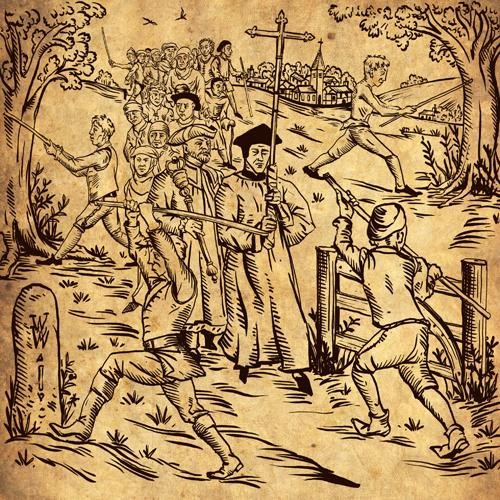
At the time most of the country was divided into parishes, with the clergy and church wardens responsible for their running and upkeep.
There were few maps back then and those that there were didn’t concentrate on church parish boundaries though of course those who worked for the church and members of the community, knew their location and this knowledge needed to be passed down through the generations.
It was only by knowing where the boundaries of the parish were, that there could be certainty about who lived within them. This was important because who had a right to married in a church, who might be buried in the churchyard and who would be asked to put their hand into their pocket for a contribution when the church building needed repairs.
Where a parish began and ended also determined issues such as where parishioners could graze animals and the limits between various jurisdictions.
Beating the Bounds evolved into a Christian ceremony when God’s blessing was sought for seeds being sown.
Usually held on Ascension Day, five weeks after Easter it became a major event. A party of local people, usually comprised of clergymen, one of whom would head the procession, church wardens, local dignitaries, villagers and a group of boys, would walk the borders and learn the whereabouts of the boundaries by their relationship to local landmarks, such as stones, gate posts, walls and trees.
Having the boys in the party was a way to insure that the knowledge would be then passed down through subsequent generations. However they had it a bit rough, boys had to carry planks which would be laid down over streams, so that the more senior members of the group could cross without getting their feet wet.
Beating the bounds wasn’t unique to rural areas though and in the towns and cities, these planks offered safe passage over open drains and sewers. In coastal parishes which extended into the sea, boats were taken out to sail along the limits.
In the later Middle Ages, the Christian jurisdiction became connected with that of manorial estates, as landowners often gave some of that land to the church.
It was also only the clergy and some of the better educated estate owners who were able to read and write. Now the processions were joined by landowners as a means of flexing their feudal muscles and reminding tenants who held the power, by defining their rights of access, or lack of them.
Beating the Bounds also gave an opportunity to check that neighbouring landowners hadn’t encroached onto their estate.
So far there has been a lot of mention about the the ‘bounds’ but does the ‘beating’ come into it? Green birch or willow branches were used to hit the boundaries and imprint them into the memory, but it wasn’t just these parish perimeters that received a good walloping.
At certain points along the route, the boys in the group could find themselves on the wrong end of the willow whip. This was done to enforce the memory of certain spots or landmarks.
No doubt it worked – you’re unlikely to forget in a hurry the oak tree beneath the limbs of which you were given a thrashing.
It wasn’t just a beating with a stick that the boys had to endure during their Beating the Bounds experience. Pain and suffering were liberally used as memory aids.
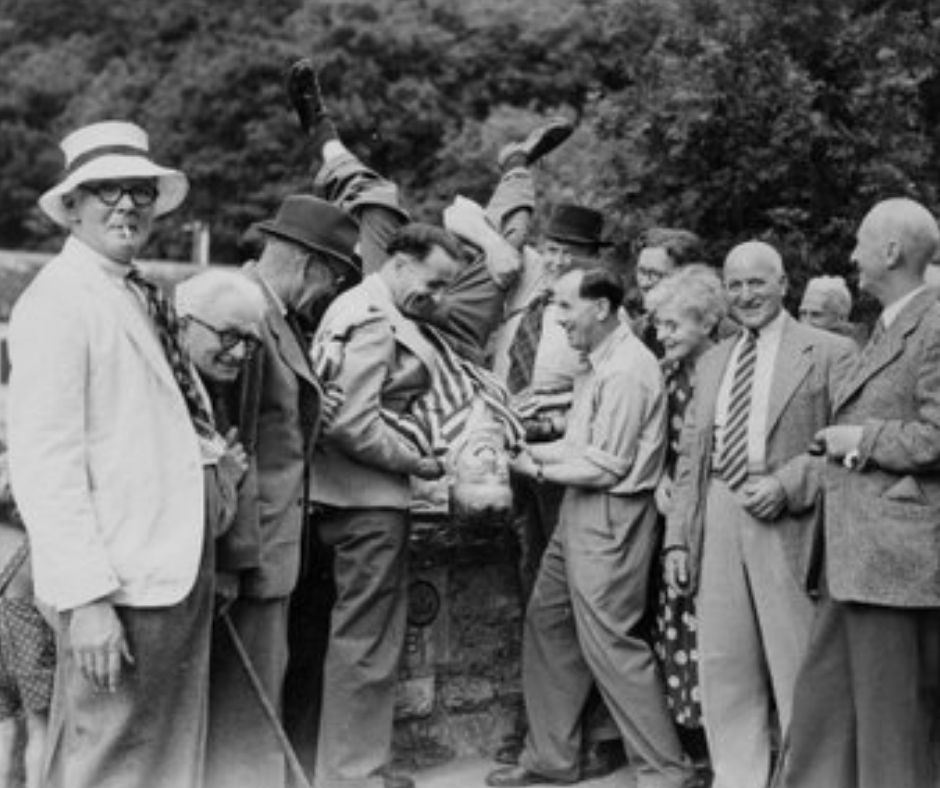
When crossing streams or passing ponds, the journey would be momentarily paused so that they could have their heads held under the water.
After being told to run along walls and narrow banks, lads would be encouraged to increase their speed until they inevitably lost their balance and fell, often into nettles or brambles.
And if the stinging prickly vegetation was an isolated patch, members of the party would be thrown into it anyway. The boys would also have their heads banged against marker stones along the route, to help remember the exact location.
It sounds like the boys version of an old witch trial! However, at the end of the ceremony they would be given tuppence each ‘for their pains’.
Over the years, the use of these violent practices died out, until they were abandoned completely, to be replaced by less painful rituals such as being given the bumps.

Along the way, the clergyman would pray for the protection of the boundary, and blessings on the residents and their activities in the coming year.
Sometimes Psalms 103 and 104 were recited and hymns would also be sung, some specific to the occasion. At the Parish Church of St Thomas a Beckett in Pagham near Bognor Regis, they sing a recently penned Beating The Bounds hymn and some of it’s words nicely encapsulate the spirit of the whole occasion.
Let us raise our joyful sounds
As we meet to beat the bounds.
As we walk the Bay Estate
Bless all those within its gates.
Thank you for our fertile lands
And each worker’s active hands.
Let us give you grateful praise
For our local shops and trades.
Except for a few years when Oliver Cromwell banned the practice, the tradition carried until the end of the nineteenth century when due to the Enclosure Acts and the transfer of church parish jurisdiction to local government reduced its popularity and indeed requirements.
Saint Martin-in-the-Fields, a C of E parish church situated on one corner of London’s Trafalgar Square, held a Beating the Bounds ceremony until the late 1800s. The procession included children from St Martins schools and they would stop outside Buckingham Palace to sing the national anthem for Queen Victoria.
Every three years, Beefeaters, local school children and scouts, still carry out the ceremony following the edges of the Tower of London Liberties, which are the boundaries of the land outside the Tower that lay under it’s control.
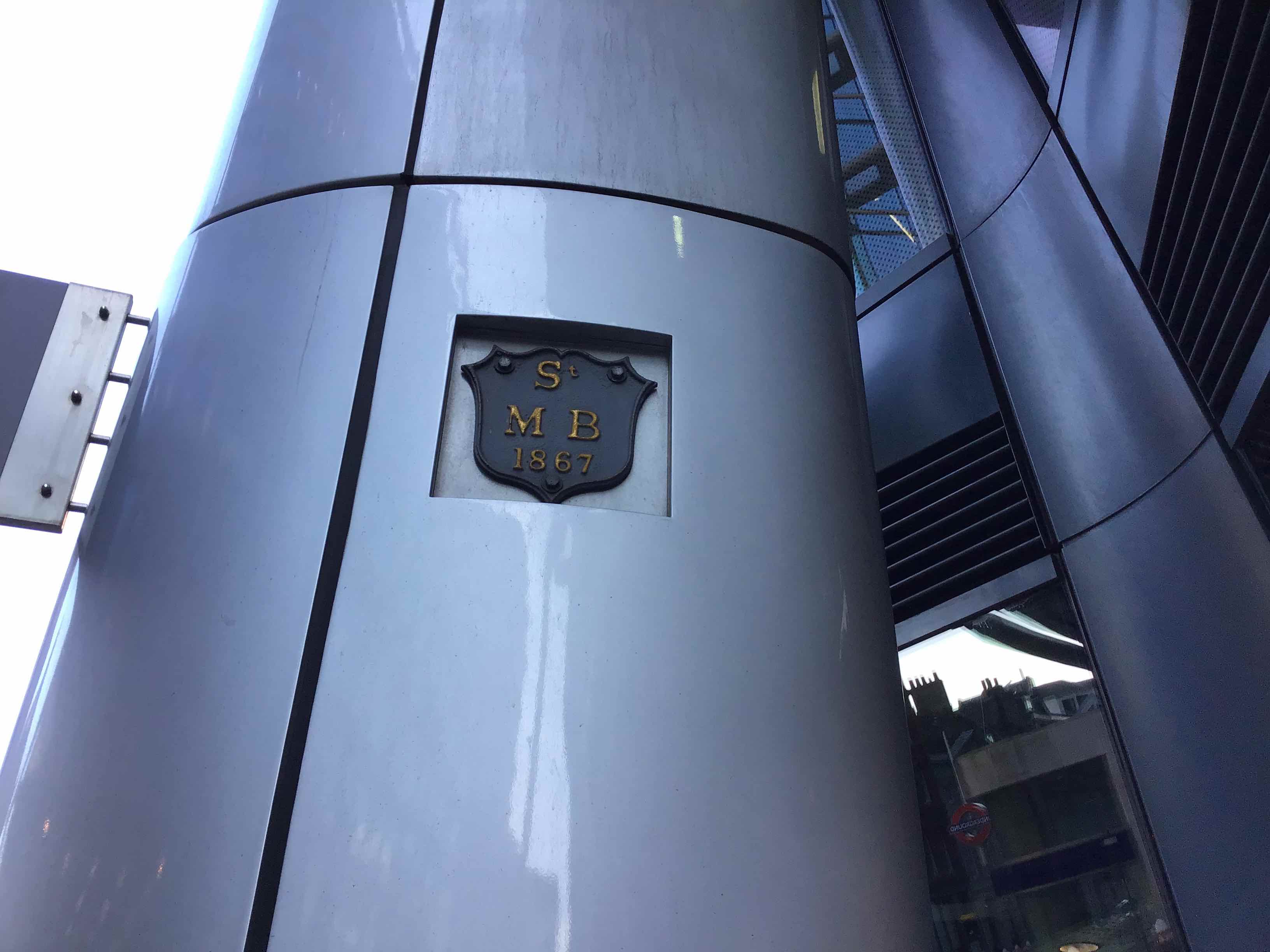
Iron markers of the border still exist and they are whipped as the procession passes by.
London’s oldest church, All Hallows which is next to the Tower, also holds it’s own Beating the Bounds and this for myself at least is the easiest one to witness.
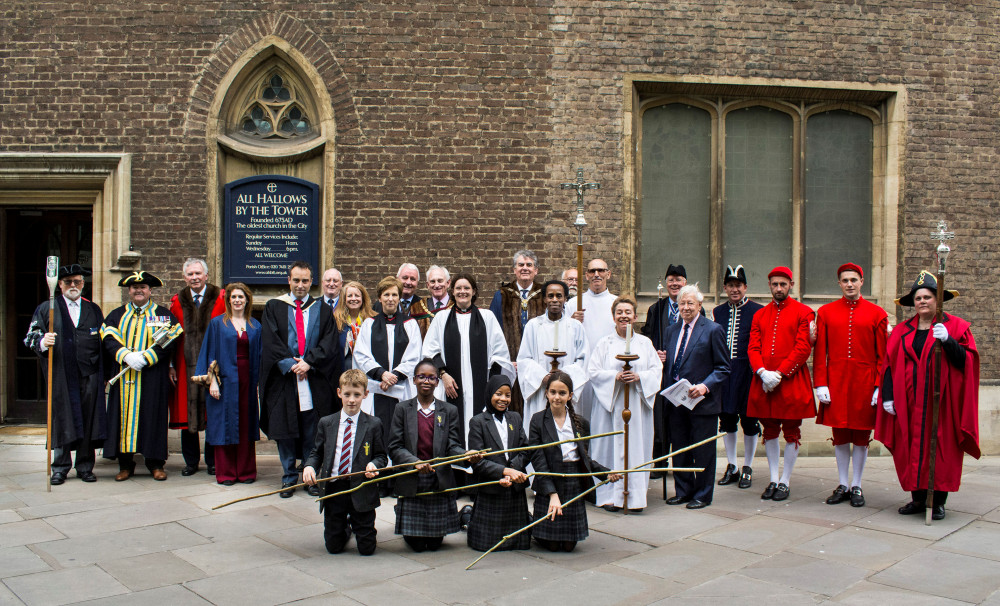
Students from St Dunstan’s College, Catford, return to their roots in the parish of St Dunstan-in-the-East to take part in the proceedings, together with the clergy and the Masters of Livery Companies associated with All Hallows Church.
As the southern boundary of the parish is in the middle of the River Thames, the group have to be taken out by boat to beat it. Then back on dry land, the procession moves around the parish, stopping where necessary for the beaters to mark the boundaries with canes.
Every third year, when the groups from both The Tower and All Hallows Church are both out marking their territories, they have a ‘battle’ at a shared boundary marker.
In medieval times this boundary was always in dispute and the meeting commemorates a day in 1698 when a disagreement between the inhabitants of the Tower itself and the people of the surrounding parish developed into a riot.
These days things are more peaceful and across the land local communities continue this ancient practice once again. It may seem arcane but there are few traditions older in the world than Beating the Bounds

 Stephen Liddell
The aide-de-memoire purpose of the willow bark survived well into the 20th century, at least till the time we went to school, under the watchful and approving eyes of the Irish brothers who ran our school.
LikeLiked by 1 person
Yes, we had the cane at our school. One of the last in Britain to actively use it until it was made illegal in the late 1980s. One teacher would give the option of one strike now or zero but if you do anything else wrong in the next month or so then 3 strikes. Happily I never had to choose!
LikeLike