I was fortunate to be in Westminster Abbey a few days. Much of the main building is perpetually overcrowded and particularly so in midsummer. There is so much to see in terms of memorials and architecture, royal thrones and the like and yet there is one place which always seems to be empty and yet to me it’s one of the things I always look forward to seeing.
Perhaps it is just me being weird, no perhaps about that obviously a few minutes from the crowds in the vestibule leading to the Chapter House at Westminster Abbey is perhaps the oldest door in Britain. If not all the ancients doors have or ever will be documented, this one at least is a very good contender.
Tests have shown that the tree which the door was made from was wood was felled sometime after 1032 AD and that the door itself was constructed sometime in the 1050s. This of course fits in perfectly with the fact that Westminster Abbey was consecrated in 1065 by our last great Anglo-Saxon King, Edward the Confessor indeed Saint Edward, an English patron saint until George muscled in on the act a few centuries later.
The ring-pattern of the timber indicates that the tree grew in eastern England, most probably coming from the extensive woodland owned by the Abbey in this area, and possibly from Essex.
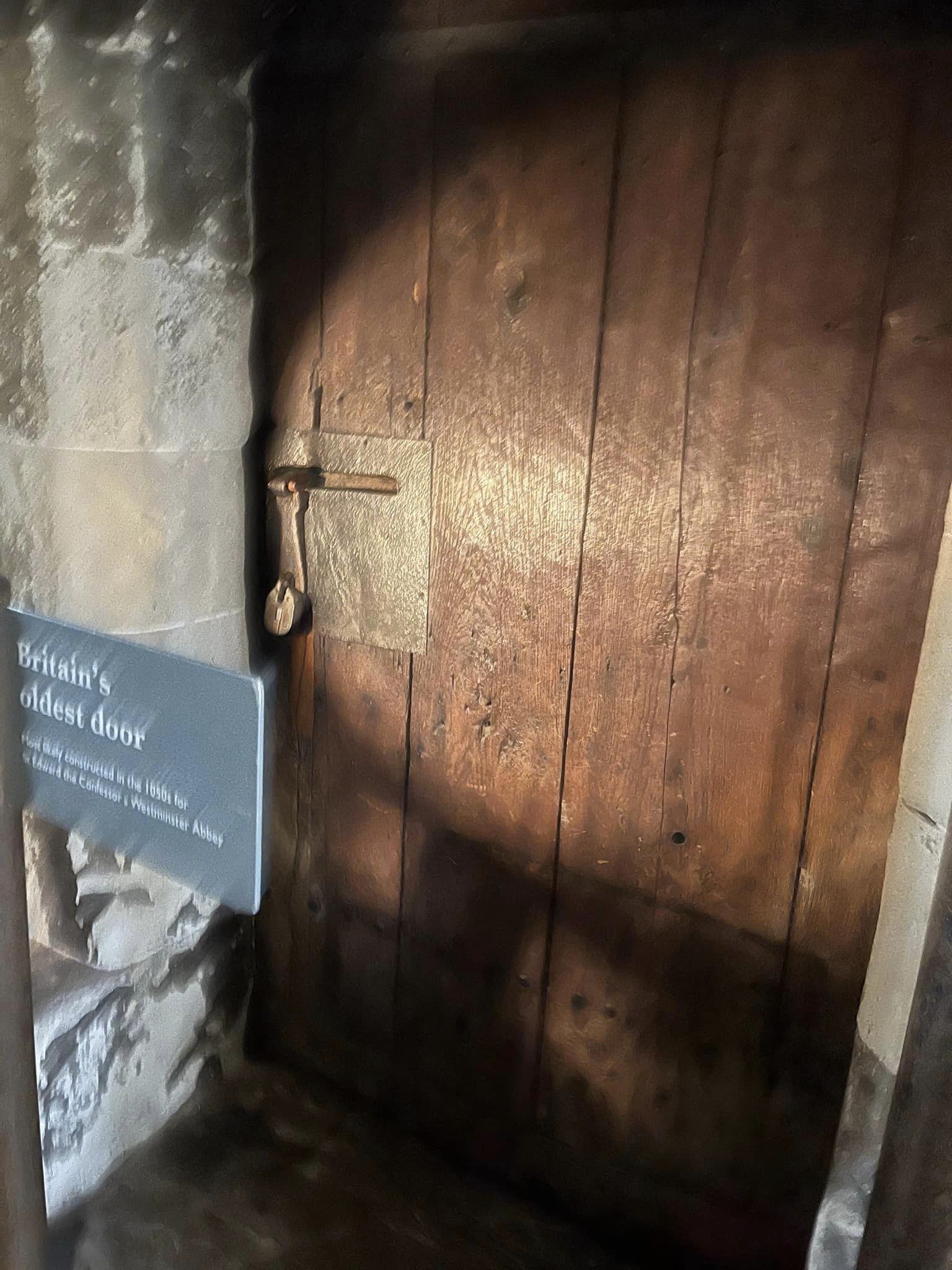
The door is made of five vertical oak planks held together with three horizontal battens and iron straps. Rather uniquely, the battens are recessed into the planks so that the door is flush on both sides.
The construction of this door is unique and shows that it was intended to communicate between spaces of equal importance in the Abbey as neither side has any ‘ugly’ construction or fastenings standing out.
The boards are from a single tree and rings on them show growth during the years from AD 924 to 1030. As the bark was trimmed when the planks were made into a door it means the exact year of felling cannot be known.
The door has been cut down and now measures 6.5 feet high and 4 feet wide and leads into a small narrow room, its original location remains unknown.
The top was almost certainly round-arched and would have been around 9 feet high originally. After the planks were fitted together probably both faces were covered with cow hide, added to provide a smooth surface for decoration (no trace of painting remains). Then the ornamental iron hinges and decorative straps were fixed.
Today there remains only one of the original straps survives and on the inner face of the door with the old hide trapped underneath it
In the 19th century when the fragments of cow hide were first noted, a legend became widely popular that this animal hide was actually human skin. Legend has it that It was someone had been caught committing sacrilege or robbery in the church and had been flayed and his skin nailed to this door as a deterrent to others.
Some less scrupulous tour guides still spout this myth while those of us who were Excluded would quite happily see the odd ex and current Prime Minister make the myth a reality but some things just aren’t meant to be I guess.

 Stephen Liddell