Maritime history and the Royal Navy in particular is rich in tales of daring-do’s, inspeakable suffering and survival against all the odds. Whether it is Captain Bligh, Fletcher Christian and The Mutiny on The Bounty or the more recent Ernest Shackleton and the Third Man (an Angel) For every Lord Nelson Original hand-drawn battle plans by Admiral Lord Nelson for the Battle of Trafalgar are discovered there is a Charles Darwin or a Grace Darling – A Victorian Heroine All equally inspiring in their own ways (or as in the case of something like HMS Terror, a total horror) but given there are so many examples, it is not hard to imagine there are still many cases lost to time.
One such event is that of the voyage of HMS Wager with a big screen film in the works made by Martin Scorsese. We go back to the year 1740 and we’re in the midst of the “War of Jenkins’ Ear” between the United Kingdom and Spain during which Commodore George Anson set off at the command of a squadron of eight ships on a circumnavigation of the globe. Their aim was to capture treasure-laden ships, and disrupt Spanish trade in the Pacific.
What followed was a hellish voyage devastated by bad weather, accident, and scurvy – the mysterious “plague of the seas” caused by Vitamin C deficiency. As the fleet neared Cape Horn (at the foot of South America), one captain wrote in his log of conditions so unbearable “that words can not express the misery” as his men dropped around him and were devoured by rats and that’s before things even get going.
HMS Wager was a square-rigged, sixth-rate Royal Navy warship of 28 guns. She was built as an East Indiaman in approximately 1734 and made two voyages to India for the East India Company.
The Admiralty purchased Wager from Mr J. Raymond on 21 November 1739, and rated her as a 28-gun sixth-rate. HMS Wager was to fill in a squadron under Commodore George Anson that would attack Spanish interests on the Pacific coast of South America. Her role was to carry additional stores of small arms, ball and powder to arm shore raiding parties. She was fitted for naval service at Deptford Dockyard between 23 November 1739 and 23 May 1740 at a cost of £7,096.2.4d and was registered as a sixth rate on 22 April 1740, being established with 120 men and 28 guns.
Commodore Anson’s squadron consisted of some 1,980 men (crew plus infantry), of whom only 188 would survive the voyage. It included six warships and two victuallers (supply ships) in addition to Wager:
- Centurion, the flagship (a fourth-rate ship of 1,005 tons, 60 guns, and 400 men)
- Gloucester (866 tons, 50 guns, 300 men)
- Severn (683 tons, 50 guns, 300 men)
- Pearl (559 tons, 40 guns, 250 men)
- Wager (559 tons, 24 guns, 120 men)
- Tryal (201 tons, 8 guns, 70 men)
The two merchant vessels were Anna (400 tons, 16 men) and Industry (200 tons), and they carried additional stores. The squadron also included 470 invalids and wounded soldiers from Chelsea hospital under the command of Lieutenant Colonel Cracherode. Most of these men were the first to die during the hardships of the voyage and including them on such a voyage seems unnecessarily cruel and ineffective even by the standards of the day.
The squadron took forty days to reach Funchal where they replenished supplies of water, wood and food before making the Atlantic crossing to Santa Catarina which is in modern day Brasil. Two weeks into this leg of the journey, the store ship Industrysignaled to Anson that it required to speak to him. The captain of Industry told the commodore that his contract had been fulfilled and Industry needed to turn back for England. Her stores were distributed among the remaining ships, with a large quantity of rum sent aboard Wager. Her cargo now consisted of rum, siege guns to attack fortified Spanish holds, and trading goods for use with coastal inhabitants, to be traded for supplies for the squadron and used to subvert Spanish rule.
Many men in the squadron died of scurvy due to lack of fresh citrus fruits or meats. The high contingent of invalids in the squadron and the outbreak of scurvy meant that Anson’s squadron was in poor condition for the arduous rounding of Cape Horn.Anson moved Captain Dandy Kidd from Wager to the Pearl and Captain Murray to Wager. Kidd died after the squadron left Santa Catarina and before they reached the straits of Staten Island. He allegedly made a deathbed prediction of success and riches for some, but death and devastating hardship for the crew of Wager.
Commodore Anson now moved Captain Murray from Wager to Pearl, and moved Lieutenant David Cheap from the small sloop Tryal and promoted him to captain of Wager. This marked the first time Cheap had been put in command of a large vessel, which was crewed by sick and dispirited men. He compounded these handicaps by denigrating the technical abilities of many of the officers, and being easily moved to fits of rage. Cheap was, however, a capable seaman and navigator, a big man who feared nobody, and a loyal and determined officer. Anson impressed on Cheap the importance of Wager and her role in the mission, as the squadron would draw on her store of small arms and ammunition to attack shore bases along the coast of present-day Chile.
The delays of the voyage were most keenly felt when the squadron rounded Cape Horn. Weather conditions were atrocious; high sea states and contrary winds meant that progress west was very slow. Added to this was the deteriorating health of Wager‘s crew: because of scurvy, few able-bodied seamen were available to work the ship and carry out running repairs to the continually battered rigging.
After many weeks working westwards to clear the Horn, the squadron turned north when navigational reckoning suggested enough westerly had been made. At this time latitudinal determination was relatively easy with the use of a sextant; however, longitudinal determination was much harder to predict: it required accurate time-pieces or a good view of the stars on stable ground, neither of which were available to the squadron. Longitude was predicted by dead reckoning, an impossible task given the storm conditions, strong currents and length of time involved. The intention was to turn north only when Anson was reasonably certain that the Horn had been cleared.
The result was nearly a complete disaster. In the middle of the night, the moon shone through the cloud for a few minutes, revealing to diligent sentinels aboard Anna towering waves breaking onto the Patagonian coastline. Anna fired guns and set up lights to warn the other ships of the danger. Without this sighting, the whole of Anson’s squadron would have been wrecked, with the likely loss of all hands. The ships turned around and headed south again into huge seas and a foul wind. During one particularly severe night, Wager became separated from the rest of the squadron and would never see it again.
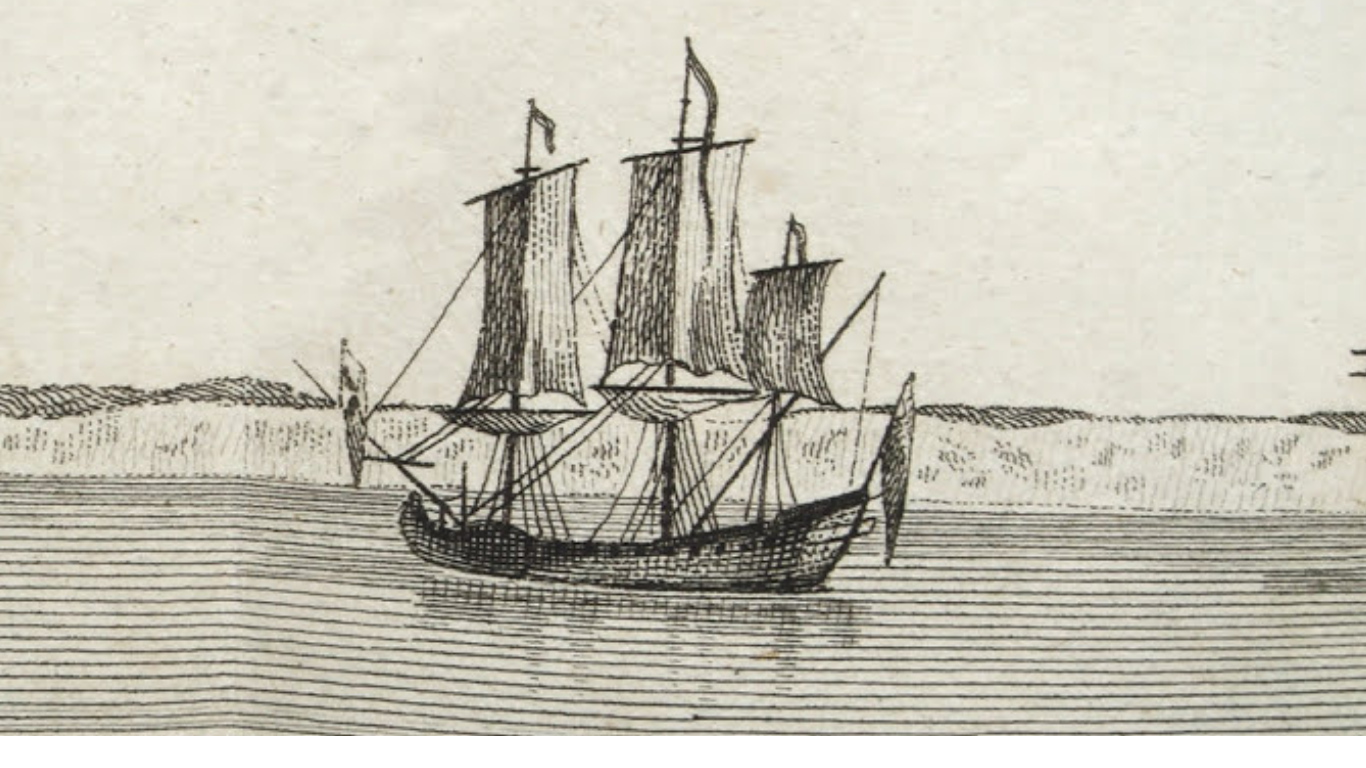
HMS Wager was now completely alone and continued beating to the west as debate arose amongst the crew as to the appropriate time to turn north; if done too early, the ship would most likely run aground. However, more crewmembers were coming down with scurvy each day and there was a shortage of seamen to handle the ship. The dilemma became contentious when Captain Cheap stated his intention to make for Socorro Island. The gunner, John Bulkley, objected strongly to this proposal, arguing that they make the secondary squadron rendezvous, the Island of Juan Fernandez, their primary destination; it was not as close to the mainland as Socorro and was less likely to result in the wrecking the ship on a lee shore. Bulkley was recognised as probably the most capable seaman on the ship; as gunner, he had officer rank. Navigation was technically the responsibility of the master, Thomas Clark, but he, along with most of the officers on board, was held in thinly-disguised contempt by Cheap.
Bulkley repeatedly tried to persuade Cheap to change his mind, arguing that the ship was in such poor condition that the crew’s ability to carry the required sail-plan to beat off a lee-shore or come to anchor was compromised, making Cheap’s decision to head for Socorro too hazardous, especially given that the whole area was poorly charted. In the event Bulkley was to prove exactly correct, but Cheap refused to change course. What Bulkley did not know was that Cheap was following his orders and it was impressed upon him that the siege guns in the hold of Wager were required for attacking Valdivia in what is now southern Chile. These orders were secret and the rumours Bulkley perpetuated that Juan Fernández was their secondary rendezvous were not correct.]
On 13th May 1741, at 9 am, John Cummins, the carpenter, went forward to inspect Wager‘s chainplates. Whilst there he thought he caught a fleeting glimpse of land to the west. The lieutenant, Baynes, was also on deck but saw nothing, and thus the sighting was not reported. Baynes was later reprimanded at a court martial for failing to alert the captain. Unbekownst to the crew, Wager had entered a large uncharted bay, now called the Gulf of Penas, and the land to the west was later to be called the Tres Montes Peninsula
At 2 pm, land was positively sighted to the west and northwest. All hands were mustered to make sail and turn the ship to the southwest. During the frantic operations which followed, Cheap fell down the quarterdeck ladder and dislocated his shoulder, resulting in his being confined below. There followed a night of terrible weather, with Wager in a disabled and worn-out condition, which severely hampered efforts to get her clear of the bay. At 4:30 am, the ship struck rocks repeatedly, broke her tiller, and although still afloat was partially flooded. The crew below who were too sick to move were drowned. Bulkley and another seaman, John Jones, began steering the ship with sail alone towards land, but later in the morning the ship struck again, this time fast and there was no moving her.
My next post will continue with the Mutiny of HMS Wager.

 Stephen Liddell
Sounds like one of Grahams ex ships on a good day😆😆😆😆😆😆😆😆 hokle erbhush.
LikeLiked by 1 person