Some attention is always given to the famous Scottish Stone of Scone which for centuries has been placed under the coronation throne and indeed was there when King Charles III was crowned. What perhaps is less well known that there is very much an English equivalent and it’s not one of those half hidden ancient monuments that are hard to find.
The Coronation Stone or perhaps Kings Stone is actually very easy to find in the middle of the street in Kingston Upon Thames and it is thought that anything from about two to eight or nine Anglo Saxons kings may have been crowned on it.
It should be said that in old English, any place name that has a ton at the end of the word is actually a settlement or farmstead so the place is more likely to be named as a farmstead of kings rather than the stone itself but hey, it all adds to the mythos doesn’t it!
One of the best historical records from the time is the Anglo-Saxon Chronicle and it clearly states that two tenth-century kings were consecrated in Kingston: Æthelstan in 925, and Æthelred the Unready in 978.
There are other kings who are said to have been crowned there, but for whom the evidence is less substantial: Edward the Elder (902), Edmund I (939), Eadred (946), Eadwig (956), Edgar the Peaceful (circa 960) and Edward the Martyr (975) – and possibly King Aethelred the Unready in 978.
Where the coronations took place after King Aethelred’s death is not precisely known as it was a particularly turbulent period in history. It may have been here, in London or wherever the monarch found themselves when they heard the news. The last King of the Anglo-Saxons, Harold II was crowned in Westminster Abbey on the 6th January 1066 and all coronations since then have been held in the same spot presumably as a monarch is anointed and rules due to the will of God and so an Abbey was seen as a little more appropriate.
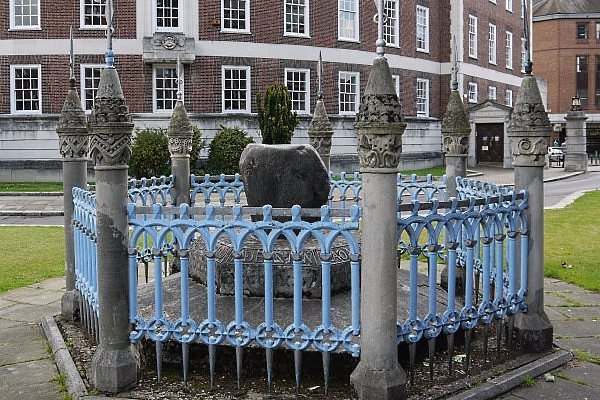
Of course it is a little hard to know with total certainty that this stone is the old Coronation stone. It is interesting to know that the stone is a Sarsen stone, similar to what is found at Stonehenge and other prehistoric sites and it is not local to Kingston.
For centuries the Coronation Stone was kept in the old church of St Mary but sadly it collapsed in 1730 though it is said to have been recovered and sited in the local market places before Victorians decided its situation should be a little more regal in appearance and relocated a short distance to where it stands today.
There are records of a Coronation Stone being kept in the ancient church of St Mary, but it collapsed in 1730, and the earliest record doesn’t appear in print until after that happened. The story goes that from the rubble, they recovered a stone — but whether they picked the correct stone out of the rubble is unknown. The Coronation Stone we see today could well be a chunk of rubble from a pillar, or the kitchen, or the loo.
That it might be a random lump of stone is supported by the fact that it was initially used as a mounting block, which seems an odd use for such a historic stone.
However, in 1850 it was moved to a more dignified place in the market before finally being moved to its current location in the grounds of the Guildhall.
Surrounded by railings and only restored last year as part of the Platinum Jubilee celebrations, and the plinth still shows the presumed Kings crowned on the stone.
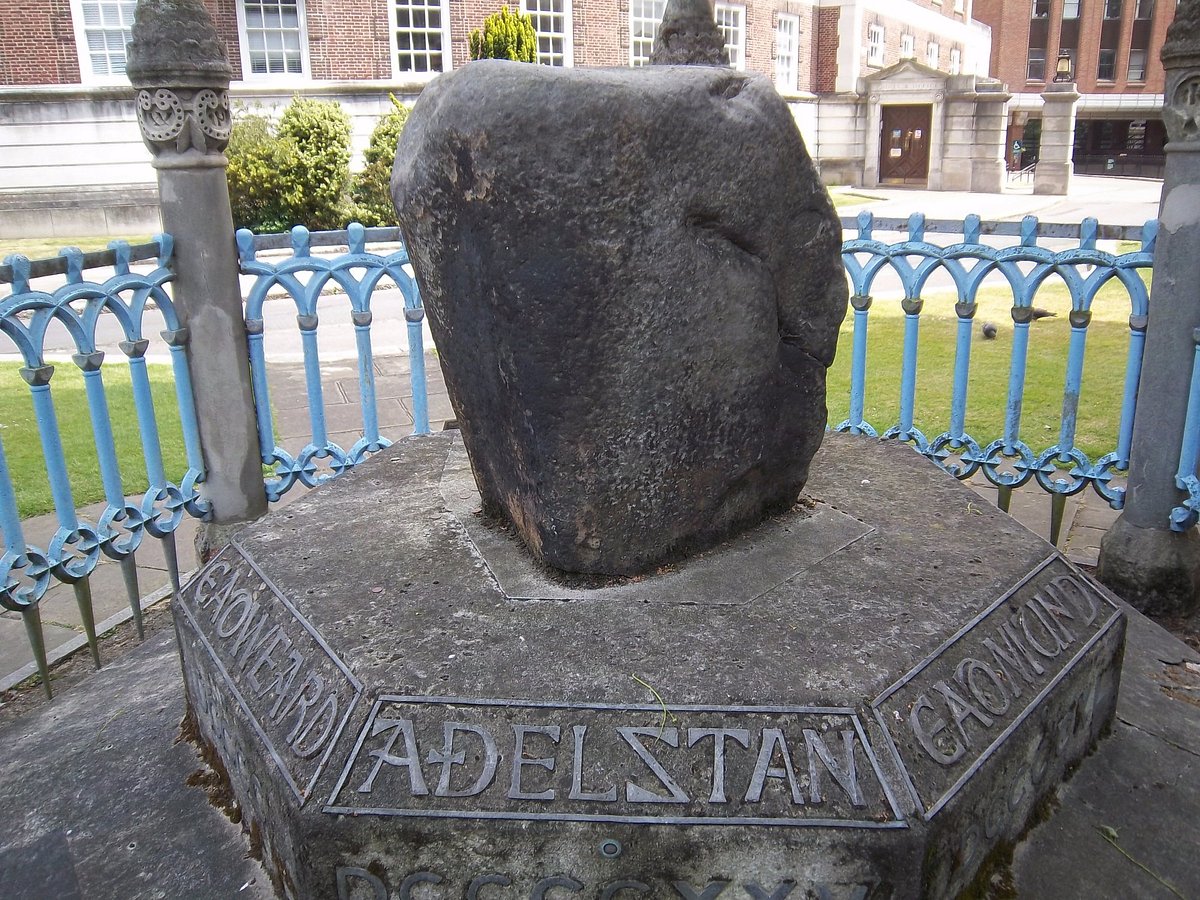
Now it is simply almost a footnote in English and Royal history that offers us a precious link with Anglo-Saxon England.
While we are talking a bit of old Anglo-Saxon and have used the letter a few times in this post, why not take a peek at https://stephenliddell.co.uk/2017/03/03/aedifying-use-of-ae/

 Stephen Liddell
1 comment