If you go in the big long gallery on the right of the ground floor of the British Museum, most people will flock to the legendary Rosetta Stone which these days rather politically correctly is a duplicate of the original.
I was there recently and it is a marvellous object though the crowd of Spanish tourists assembled around it looked bored out of their mind. Perhaps their group guide wasn’t the best? Either way, just a minute or so away is a little treasure which might be less renowned but is nonetheless beautiful to look at and for some has a deep religious connection.
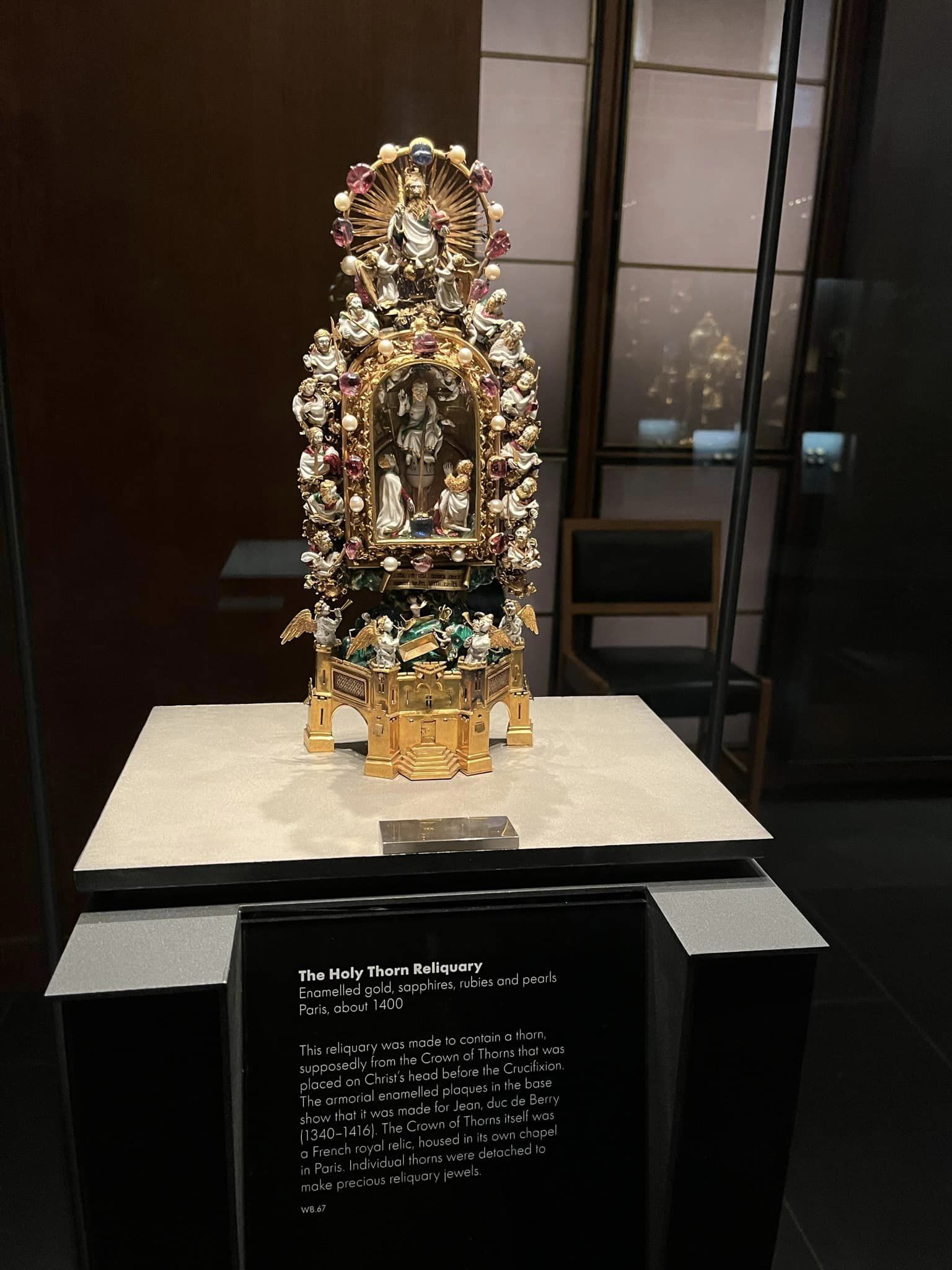
This is an old French treasure made in the 1390s for the Duke of Berry. It is a reliquary of gold, richly enamelled and set with rubies, pearls and sapphires. Architectural base in form of castellated fortress with a half-length angel sounding a trumpet occupying each turret, base also with arms of Jean, duc de Berry in rectangular panels of blue and red translucent enamel.
There is a depiction of a fortress, angels and the Resurrection of the Dead as well as the Twelve Apostles, Saints, a baby Jesus and even God and the Devil along with many other figures. The beauty and craftsmanship alone make it worth spending some time admiring it.

Whilst it’s undoubtedly an incredible work of art, it takes on even further significance considering it is a reliquary. About 150 years earlier, King Louis IX of France had purchased the Crown of Thorns that the Romans supposedly put on the head of Jesus at his crucifixion. If you look closely in the centre of the reliquary then you can see one of those thorns.
I’d think it would be a bit weird to do so having survived 1200 years or so but apparently the King dismantled the crown and gave thorns away to reward and win favours with important figures in his kingdom. And so this particular Duke decided to house his in this wonderful work of art.
It’s always a bit difficult to work out the authenticity of reliquaries, some of them have a fine documented heritage that can more or less be proven whilst others were outright frauds created just to make money. Just which head of John the Baptist is real for example (one for a future blog post I am sure).
Whatever the provenance of the relic itself, there is no denying what a wonderful work of art the Holy Thorn Reliquary is. Next time you are at the British Museum and you get tired of jostling the crowds to see the Rosetta Stone, why not pop down and see this instead?

 Stephen Liddell