If you’ve ever been to a disco or club with the intent of meeting that special someone you may have heard of it as ‘going to the meat market’.
In yesteryear, men were unable to obtain a divorce without invoking a special Act of Parliament, a protracted and expensive business and ladies had even less of a say in things. As always, especially in London, where there is a will there is a way and people would find their own way of bypassing rules and regulations. And so custom the custom of wife-selling became popular despite it having long ago been had been legislated against in the reign of King Canute.
The common practice was for the husband to place a halter around his wife’s neck and lead her to market, where a ticket was purchased in order for proceedings to get underway. She was then led around the market several times (“a custom that was believed to legalise the proceedings”) before being auctioned off.
As depraved as this may sound to modern sensibilities (and, indeed, it sounded pretty depraved in the 19th century, too, with one newspaper noting, “We could mention a way in which a rope might very properly reward the persons concerned”) the spectacle was not always as inhumane as ig might sound.
The wives were often just as keen to get out of the marriage as their want-away husbands, and on many occasions the setup simply allowed for both parties to commit adultery in what they optimistically hoped might be the eyes of the law. The wives’ lovers, if they existed, would come to market and pay to take them away so it was an arrangement that ultimately suited everyone and was considerably cheaper than divorce.
It was a commonplace occurrence. In July 1815 a wife was brought to Smithfield market by coach, and sold for 50 guineas and a horse. Once the sale was complete, “the lady, with her new lord and master, mounted a handsome curricle which was in waiting for them, and drove off, seemingly nothing loath to go.
Sales became more common in the mid 18th century, the result of husbands being abroad in the military, navy, or being transported to the colonies. It was commonly believed that an absence of 7 years constituted a divorce, so when the first husband returned to find his wife had a new family, the dilemma was solved by the first husband selling his wife in the market place for a nominal sum. It was not recognised as legal, as one wife had to wait for her first husband to die before being able to marry the father of her children. She was given away by her grandson
Of course it wasn’t officially legal at all. When a young woman was taken before the justices at Smithfield, one of them remarked that if it were legally possible for a man tired of his wife to dispose of her at market, Smithfield would not be big enough. This suggests there were a lot of unhappy marriages at the time
If it sounds a little harsh even for the time then we aren’t the only ones to think it. Whilst sometimes large crowds would assemble for spontaneous auctions other sellers faced the wrath of the public for their barbarity.
On Friday a butcher exposed his wife to Sale in Smithfield Market, near the Ram Inn, with a halter about her neck, and one about her waist, which tied her to a railing, when a hog-driver was the happy purchaser, who gave the husband three guineas and a crown for his departed rib. Pity it is, there is no stop put to such depraved conduct in the lower order of people.
The Times (July 1797)
I go past a black and white sketch of the artwork below quite regularly on my Pub Tour. It always makes me laugh as the poor lady is a little unfortunate looking whilst the husband is hardly the most handsome fellow in London.
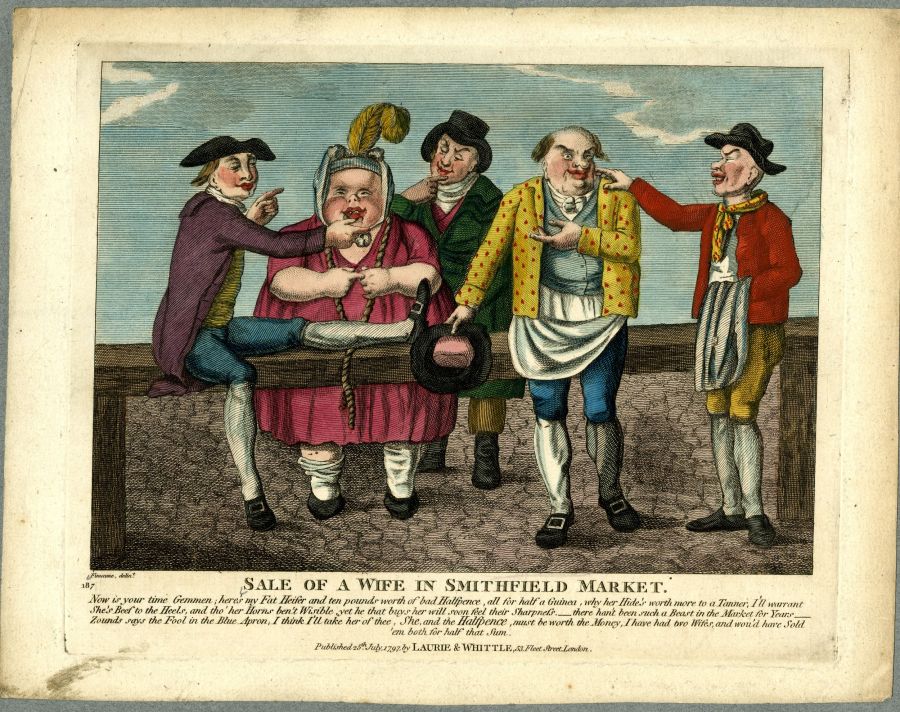
This could be John Hobbs? Having taken his wife, Jane, to Smithfield meat Market, he finds that nobody wants to buy her, largely due to her understandably bitter disposition.
Maybe through frustration or maybe due to the public humiliation, John Hobbs takes the rope from around his wife and hangs himself with it! Though there is a happier variation where the wife cuts him down and they go home together to resolve their differences. Knowing Smithfield as I do, it is not necessarily a place one might think of when it comes to happy endings!
By the 1880’s only a few people a year were being sold or swapped at Smithfield and the last recorded case of a wife being sold off in this manner anywhere in England was in Leeds, Yorkshire where a lady testified in court that her husband sold her to a work colleague for £1 which was a large sum in those days.
Wife swapping and trading was quite a thing in Smithfield, some of my tourists ask me what hours does this operate 
If you’d like to visit yourself, check out my tours. The meat market also features on two of my virtual video tours so you can enjoy this fascinating part of London with me from the comfort of home!

 Stephen Liddell
Damn. They do wife stealing races in northern Maine. Winner wins the wife’s weight in beer. Comes from the same tradition as having a best man.
But this? This is next level hardcore.
LikeLiked by 1 person
Bet the title will bring readers in droves to this post 🙂 Perhaps both male and female. Which will further support yr statement that it might not have been as barbaric a transaction as it sounds.
LikeLiked by 1 person
Yes I thought I would win a whole new bunch of readers lol
LikeLike