For such a dominating historical figure, there are pretty few statues of King Henry VIII left with us and indeed there is only one in the whole of London. If you’ve never seen it then you’ve likely never been on one of my tours and you definitely haven’t been to Smithfield.
It is thought likely that a main entrance to St Parts hospital has been at this location since the early 12th century, looking out over the historic open ground of Smithfield but the current gate house was built in 1702 with a budget of £550.
The man responsible for the gate was Edward Strong and he came from a notable family of stonemasons; his uncle had been Chief Mason to Sir Christopher Wren, and he himself had worked under Wren at St Paul’s Cathedral. The building work was completed in the late spring of 1703, but the cost proved to be considerably higher than the original estimate: £1493 had already been spent by Michaelmas 1702, and a further £1320 was spent before the Gate and adjoining houses were finished. A clock to adorn the façade of the Gate was made by Richard Horton in 1702. All of this was a lot of money in those days so it seems a little unreal that this winter it will be the general price of heating a home in London this winter!
The crown and sceptre of King Henry VIII were made in 1987 as the originals had decayed beyond repair. Above the King are two further sculptures, one holding a crutch, the other with his right arm in a sling. These are thought to be allegorical figures of Lameness and Disease.
In 1833-4 the Gate was substantially reconstructed. The 18th-century facade overlooking West Smithfield remained unaltered, but the houses immediately adjoining the Gate were demolished, and ground and first floor rooms were added on either side of the central arch. The rear of the Gate was re-modelled and faced with stone at the same time.
The Gate has had many uses. In 1834, it was employed as a residence for the house surgeons, and in the early 20th century the rooms were lived in by the hospital beadles and their families. More recently the Gate has been used as office accommodation. It was restored in 1969 and again in 1985-7 when a Civic Trust commendation was made for the restoration work.
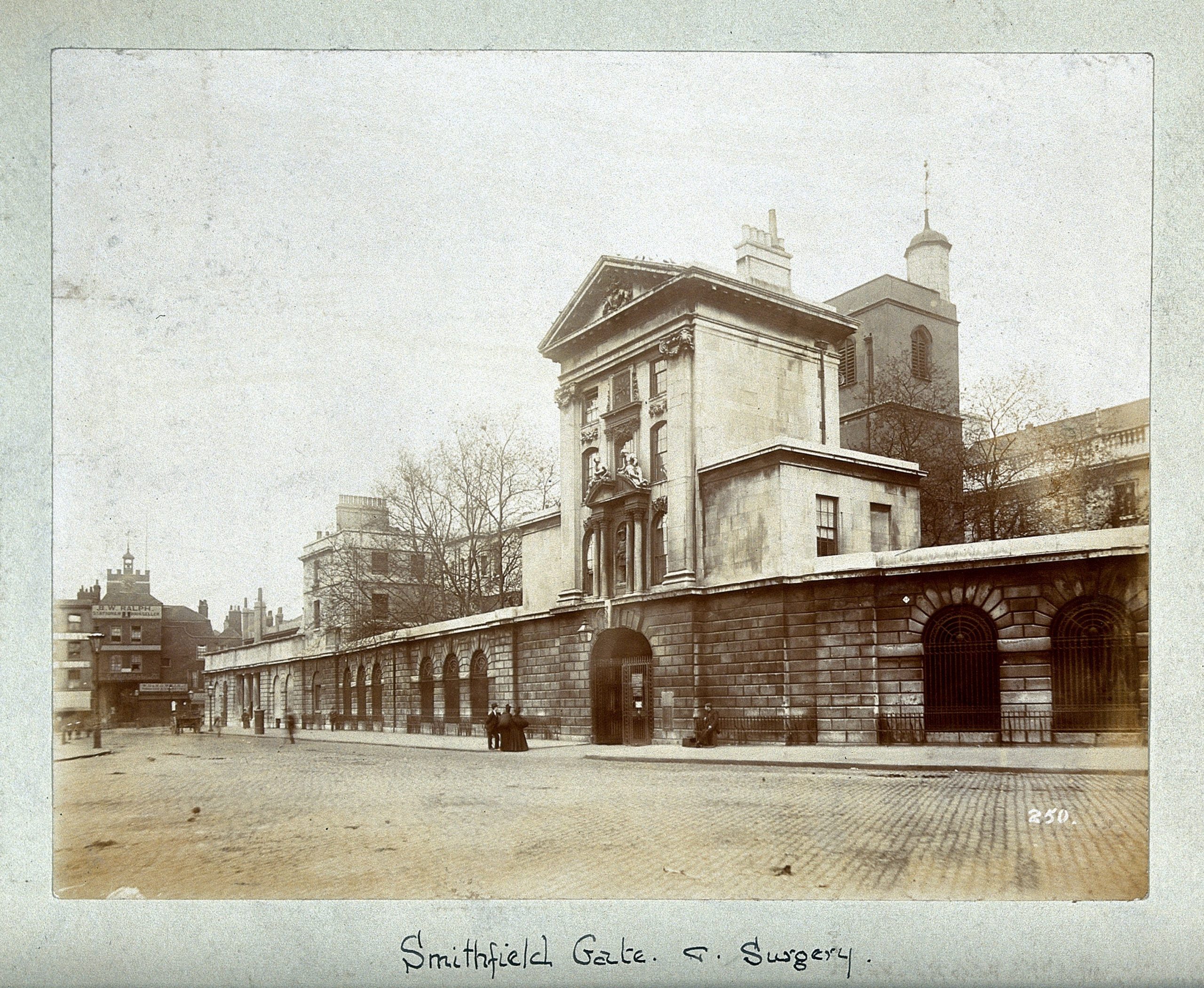
This old photo above is I think tremendous seeing as I seem to spend half my life around here and went by twice yesterday alone. Despite the great changes in the well over a century since this photo was taken, it’s still very recognisable to me. I’d date it to before 1917 because the building in the background on the left now looks totally different following its facade being dislodged/blown off in a WW1 bomb attack by Germany.
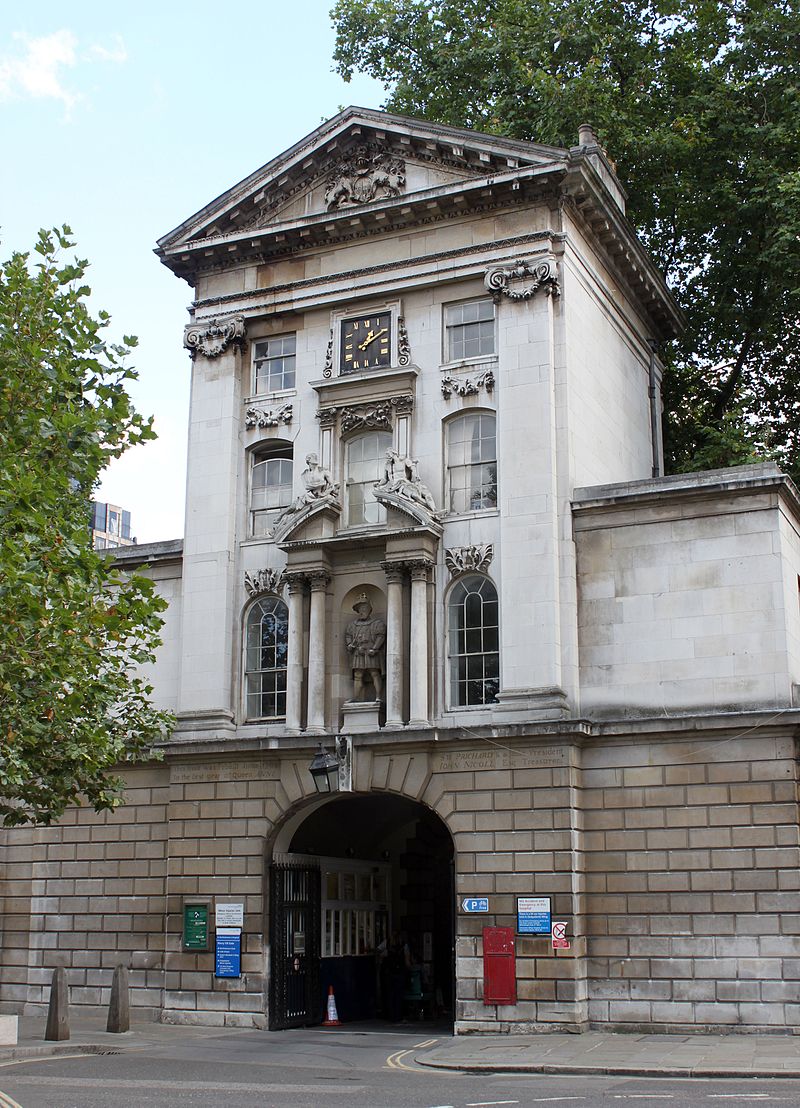
And above is how I’ve always known it though currently it’s been covered in scaffolding and hidden from view for a year or so as restoration works proceed. Hopefully having waited 500 or so years to see a statue of King Henry VIII, you can wait a few months more!
A minute or so walk away is The statue of Peace in Smithfield with its secret sign of fidelity. If you can’t visit London in person (lots of my tours come by this very spot) then you can always check out my first video tour which I did as a fundraiser https://yeoldeenglandtours.co.uk/our-tours-2/virtual-video-tours-2/

 Stephen Liddell