The Pilgrim Fathers were an interesting bunch, although I am somewhat embarrassed to say that I knew very little about them when I started writing this. In 1586, under the reign of Elizabeth I, a group of post-Reformation religious dissenters were imprisoned in The Clink in Southwark (another venue we visit on this tour), for beliefs that challenged the official Anglican religions.
Undeterred, they founded a prison church to pursue their religious interests, describing themselves as Independents, although they are usually referred to as Brownists. The leading figures were John Greenwood, Henry Barrowe, Robert Browne, Francis Johnson, John Penry and Roger Rippon. They were temporarily released, and continued to practice their own religious ideas, for which Greenwood, Penry and Barrowe were all eventually executed, whilst Robert Rippon died in prison. Some of the other members also fared badly. Francis Johnson travelled as far as Newfoundland to find a place where the Independents could settle without persecution, but settled in Leiden in the Netherlands, where he was joined by other believers from Southwark, where they were able to meet more freely. However, life was economically difficult in Leiden, and the group began to look at the possibilities of moving across the Atlantic in the wake of other colonists and missionaries. In 1620 they were given permission to relocate to America.
With around £7,000 in funding (a massive amount for the time) the original plan was for two ships to depart, Speedwell and Mayflower, but after a false start from Southampton on 5th August 1620, Speedwell sprung a leak, and the ships had to return to England. After a month the decision was made to abandon Speedwell so Mayflower left Plymouth on her own on the 6th September 1620, with 102 passengers, following a map published by famous explorer Captain John Smith. She made landfall 68 days after leaving Plymouth in North America on the 21st December 1620.
Showing all the usual imagination of early emigrants to America, the settlers called their new home Plymouth. The Mayflower stayed with the Pilgrim Fathers until May 1621, before returning to England. The pilgrims became icons of the quest for religious freedom, as well as being one of the very first colonies in America, and the only one that was continuously occupied. There’s a good description of the whole Pilgrim story on Wikipedia.
The Mayflower was already quite an old ship when she took on the trip to North America in 1620, a three-masted and three- or four-decked Dutch cargo fluyt of around 180 tons. She was part-owned by her captain, Christopher Jones who born in not too distant Harwich was now resident in Rotherhithe at the time of Mayflower’s departure for Southampton. It was a popular place for sea captains to live in the 17th Century, and it is probable that Jones knew ship owner Edward Maister. The journey to North America was perilous and their first winter perhaps even more so and it is no doubt with a little gratitude that Captain Jones arrived back safely on the return voyage. Sadly though, he died arounda year later on the 5th March in 1622, in his early 50s, and was buried in the churchyard of St Mary’s in Rotherhithe.
Due to damage inflicted by repeated flooding, many of the old churchyard monuments and memorials were lost during this period, and the exact location of the burial of Christopher Jones is no longer known. It is fair to assume he lies somewhere near The Watchhouse Cafe I mention in an earlier post. There is a stone tablet in memory of him saved from the old church and set into the new tower’s wall. There is modern monument to him in the churchyard of St Mary’s, depicting St Christopher, the patron saint of travellers, holding a small child. It was unveiled in 1995, to mark the 375th anniversary of the voyage.
There were at least two other Rotherhithe residents who made up members of the crew, John Moore and John Clarke. John Clarke was the First Mate of the Mayflower. He was baptized at St Mary in 1575, so he was almost certainly born in Rotherhithe, and he died in 1622. Clarke Island in Plymouth Bay, Massachusetts, is named after him.
The Mayflower ship was left to rot on the shore of Thames just a few feet from where it’s famous journey had commenced though it is said that some of the timbers of the ship that were salvageable were removed for use in construction as was relatively commonplace with old wooden sailing vessels.
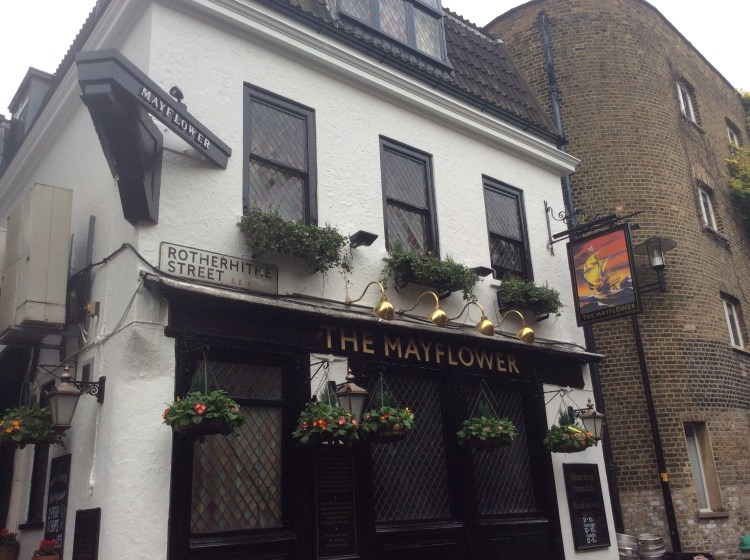
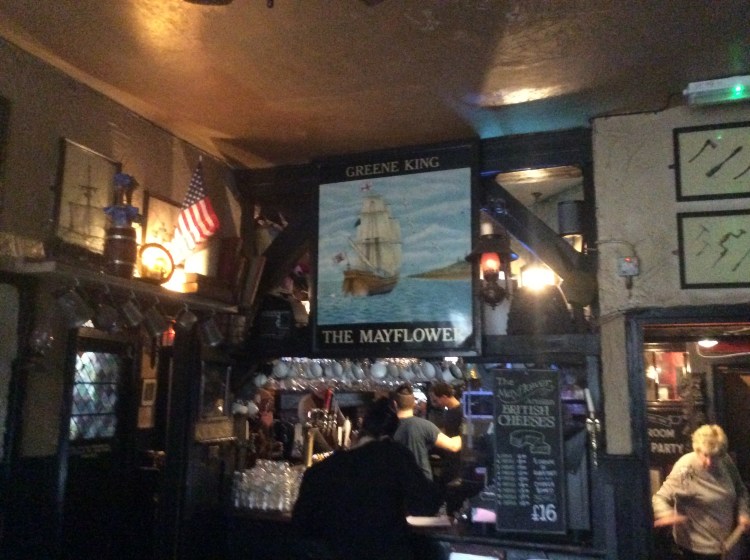
Of course, this all happened long ago and it would likely be largely forgotten about if it were not for the rather marvellous Mayflower pub.
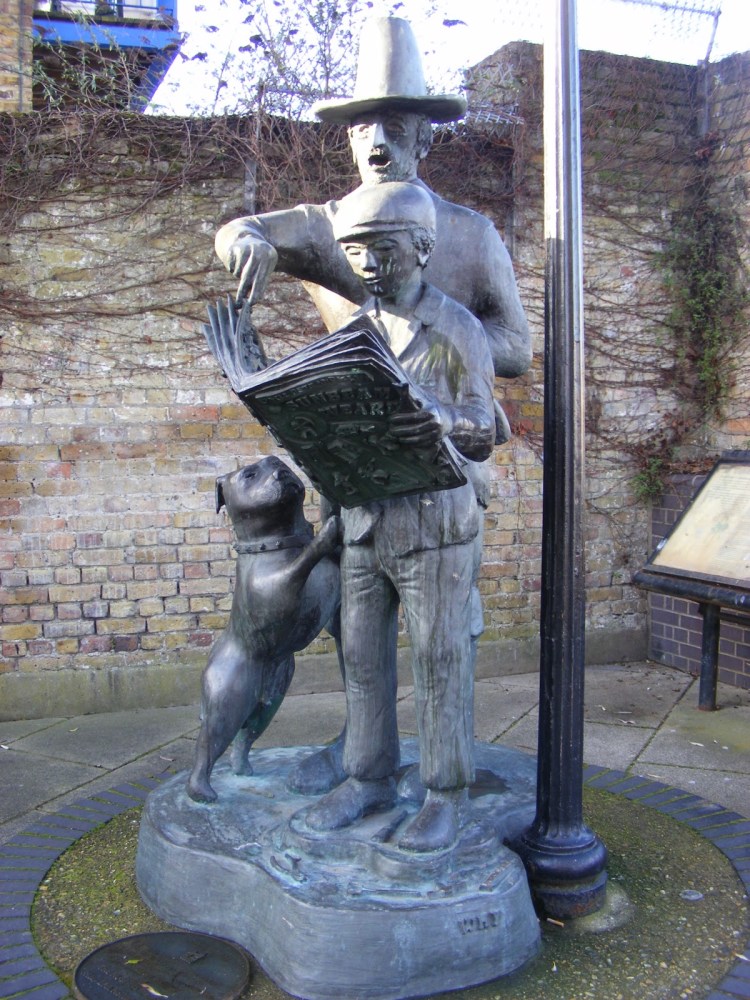
A little further along there is a further reminder of the connection between Rotherhithe and the early settlers. The statue, “Sunbeam Weekly and the Pilgrim’s Pocket” stands on the walkway at Cumberland Wharf. The work is by Peter McClean, depicting a newsboy in 1930’s attire, reading a copy of the newspaper depicting the story of “The Mayflower” and all that has happened in the USA since those early days. The pilgrim is reading the paper over the boy’s shoulder, looking astonished at how the world has developed since he landed at Plymouth Rock in 1620. The boy’s dog also appears to be trying to read the newspaper, standing on its hind legs.
That brings us to the end of this 2 mile or so walk through Bermondsey and Rotherhithe, I hope that you enjoyed all the posts of this last month or so. Which was the place that you enjoyed the most. For a recap see below!
If you’d like to tour with me on this trail that will culminate inside the Mayflower pub with its famous connections with the Pilgrim Fathers who established the USA then visit:
If you missed my first post on the area, you can read all about the The Angel Pub in Rotherhithe, which has a long and often murky history and is actually adjacent to the statue of Dr. Salter. The second post is all about the notorious Jacobs island which incredibly is now a luxory housing and retail area whilst the third and on the ruins of a manor house belonging to King Edward III which is also about 20 feet from the statues. Don’t forget the more recent post on The Watch House Cafe with its fascinating, gory past and very yummy present and future.
Don’t forget my most recent post on Dr Alfred Salter and his formidable wife Ada who more than a century ago did so much to improve Rotherhithe and the desperately poor people who lived here.
My personal favourite part of the entire walk, the Sands Film Studio and Rotherhithe Picture Library but the most recent post being on St Mary’s Church in Rotherhithe and the resting place of Captain Christopher Jones, the famous mariner who took the Mayflower and pilgrims to North America.
Not forgetting of course my previous post on the Brunel Museum and the first tunnel in the world to go under (the Thames) water.

 Stephen Liddell
Your making me thirsty is it time for some suds.
LikeLiked by 1 person
I have some in the fridge but it’s not quite the same!
LikeLike